blog
rss

More Inspiration

Croatia away from the crowds: island hopping the quiet way

Croatia's beautiful coastline is hardly a secret. Historic medieval walls in Dubrovnik and Hvar's lively waterfront draw travellers from around the world to this part of the Adriatic. But venture a little further along the coast, and you'll discover a quieter yet mesmerising side of Croatia.

Exploring Croatia by small catamaran offers a different way to experience the islands, with more time for water activities and opportunities to discover places larger vessels can't easily reach.

Here's a taste of what a week on a catamaran, sailing between Trogir and Dubrovnik, is like.

Why explore Croatia by small catamaran? 

While ferries and day trips are popular ways to visit Croatia's islands, travelling by small catamaran lets you experience the coastline at a different pace. Your accommodation travels with you, so there's no need to keep packing and unpacking. 

Croatia catamaran sailing in clear turquoise water near the coast |  Lorena Marques

Mornings might begin with a swim straight from the boat, followed by breakfast overlooking a quiet bay. During the day, you can snorkel, paddleboard, explore coastal trails, or simply relax on deck. 

And when you arrive in port, you can wander through local villages and enjoy the atmosphere, often when it's not during the busiest sightseeing hours.

7 highlights along the Adriatic coast

Šolta Island

Just a short sail from Trogir, Šolta is known for its traditional fishing villages, olive groves and sheltered bays. You can spend your morning swimming, snorkelling or paddleboarding in the clear Adriatic waters. It's a lovely introduction to island life, with no need to be anywhere in a hurry. 

Solta island  Dalmatia, Croatia

Stari Grad: Hvar's quieter side 

Hvar might be famous for its lively harbour and nightlife, but this beautiful island has another side worth exploring. On the northern coast, Stari Grad is one of Europe's oldest towns, with narrow stone lanes, historic buildings and waterfront cafes.

Stari Grad waterfront dining terrace and stone buildings beside the Adriatic Sea |  Lorena Marques

Wander through town, stop for a gelato or head into the surrounding countryside to visit a family-run farm. Here, you can sample locally produced organic wine, olive oil and Dalmatian prosciutto while learning about the island's food traditions. 

Stari Grad walking along a narrow stone laneway between historic buildings |  Lorena Marques Stari Grad stone laneway with shuttered houses and cobbled square, Croatia |  Lorena Marques Stari Grad waterfront view, island of Hvar, Croatia Stari Grad harbour lined with moored boats and waterfront houses, Croatia |  Lorena Marques
 

Stari Grad Plains, a UNESCO World Heritage site, is also well worth a visit.

The Pakleni Islands: Beautiful coves and swimming spots 

Just off Hvar lie the Pakleni Islands, a collection of pine-covered islets surrounded by some of the Adriatic's most inviting waters. Despite its nickname, the "Hell Islands", there's nothing intimidating about these beautiful little islands. 

Many of their sheltered coves and rocky beaches are accessible only by boat, offering great spots for swimming, snorkelling and enjoying the scenery.

Hvar harbour and old town seen from above, yachts moored near Croatian islands |  Lorena Marques

Korčula: Medieval streets and local traditions 

A medieval walled city of impressive stone walls, terracotta rooftops and narrow cobbled streets, Korčula is one of Croatia's most charming island towns. Often compared to Dubrovnik on a smaller scale, its historic centre is a wonderful place to explore on foot. 

Korcula stone staircase climbs to a fortified gate tower, Croatia |  Lorena Marques Korcula stone lane lined with outdoor dining tables beneath coastal pines |  Lorena Marques Korcula coastline with swimmers and sunbathers on a pebble beach, Croatia |  Lorena Marques Korcula outdoor dining courtyard with string lights and olive trees at dusk |  Lorena Marques Ocean side views as we cycle the streets of Korcula |  Kylie Turner
 

Wander through the old town, browse local shops or find a waterfront cafe to watch the boats come and go. Depending on your visit, you might also catch a traditional sword dance, part of the island's rich cultural heritage. 

A must-do highlight is climbing the ladder to Massimo’s rooftop bar for sunset cocktails. 

Korcula coastline photographed from the deck of a sailing boat, Croatia |  Lorena Marques

Mljet: National park walks, saltwater lakes and local flavours 

If you love nature and getting outdoors, Mljet will be a memorable stop. One of the greenest islands in the Adriatic, Mljet National Park features forest trails that wind around two beautiful saltwater lakes. Explore on foot or by e-bike, take a small boat to the historic Benedictine monastery on St Mary's Island or enjoy a refreshing swim in the lakes. 

Mljet riders pause beside a calm lake with forested hills behind, Croatia |  Lorena Marques

Afterwards, try peka, a traditional Dalmatian dish of meat, octopus or fish slow-cooked with vegetables beneath a bell-shaped lid. 

Octopus and potatoes roasted in a pot, a Croatian dish |  Lorena Marques

The Elaphiti Islands

Just off Dubrovnik, the Elaphiti Islands provide a welcome escape from the city's busier streets. Spend your day exploring village lanes, taking in the relaxed atmosphere of traditional Adriatic life or discover the multitude of secluded bays and hidden coves ideal for swimming.

Elaphiti Islands sailing past a waterside village on Croatia's coast |  Lorena Marques Elaphiti Islands snorkelling in clear turquoise waters off a forested coastline |  Lorena Marques Elaphiti Islands waters show a school of fish above a seagrass meadow |  Lorena Marques Elaphiti Islands paddling past anchored yachts in a wooded bay, Croatia |  Lorena Marques
 

As evening dawns, locals gather along the waterfront, children ride their bikes, and families settle in for dinner. These moments make exploring Croatia's smaller islands even more memorable. 

Dubrovnik

No journey along this part of the Croatian coastline would feel complete without experiencing Dubrovnik. While its UNESCO World Heritage-listed Old Town is well worth exploring, seeing the city from the sea offers a different perspective. 

The magnificent medieval walls rise above the coastline, with terracotta rooftops stretching across the hillside behind them. It's a memorable gateway to begin or finish your Croatian adventure. Keep an eye on the water, too, as dolphins are sometimes spotted along this stretch of the Adriatic.

The city walls of Dubrovnik

How to experience Croatia away from the busiest crowds

A little planning can make all the difference when exploring this popular coastline. 

  • Travel during the shoulder season: Late May, June and September generally offer pleasant temperatures and fewer visitors than the peak July and August holiday period.
  • Choose a smaller vessel: Small catamarans can reach sheltered bays and quieter anchorages that larger cruise ships may not. The intimate boat means you're onboard with up to 8 passengers for a voyage that feels less like a tour and more like sailing with friends.
  • Support local businesses: Eat at family-run restaurants, sample locally produced wines and olive oils, and take time to learn about the communities you visit. 
  • Slow down: Leave room for spontaneous swimming stops and conversations with locals that often become the best travel memories.

From peaceful island villages to hidden coves and traditional Dalmatian flavours, exploring by small catamaran over a week lets you experience the Adriatic at a more relaxed pace.

View our sailing trips and start planning your Croatia adventure today → 
 

Things to do in the Komodo Islands: Dragons, manta rays and so much more

When most people think of the Komodo Islands, seeing the Komodo dragon is often high on their list. And rightly so! These rare reptiles are found in the wild on just a handful of Indonesian islands, making this one of the few places on Earth where you can encounter them in their natural habitat.

But ask anyone who's been, and they'll also tell you there's a lot more to this part of Indonesia than its famous residents.

There's the sunrise climb on Padar, snorkelling alongside manta rays, and thousands of flying foxes that can fill the sunset sky. The dragons might be what first draws you here, but there's plenty more to discover once you arrive.
Pink Beach, Komodo Indonesia

One of the best ways to experience it all is by small ship, where you can explore the islands, beaches and reefs at your own pace, with a new adventure waiting just off the deck.

Here's a simple guide to get the most out of your stay.

Getting to the Komodo Islands is easier than you think

Some of Indonesia's expedition destinations take a little more planning to reach. Places like Raja Ampat and the Spice Islands can involve multiple flights and longer connections. Komodo, by contrast, is very accessible, particularly for Australian travellers. The usual route is to fly into Bali (Denpasar International Airport), then take a short connecting flight from Denpasar to Labuan Bajo on the island of Flores. 
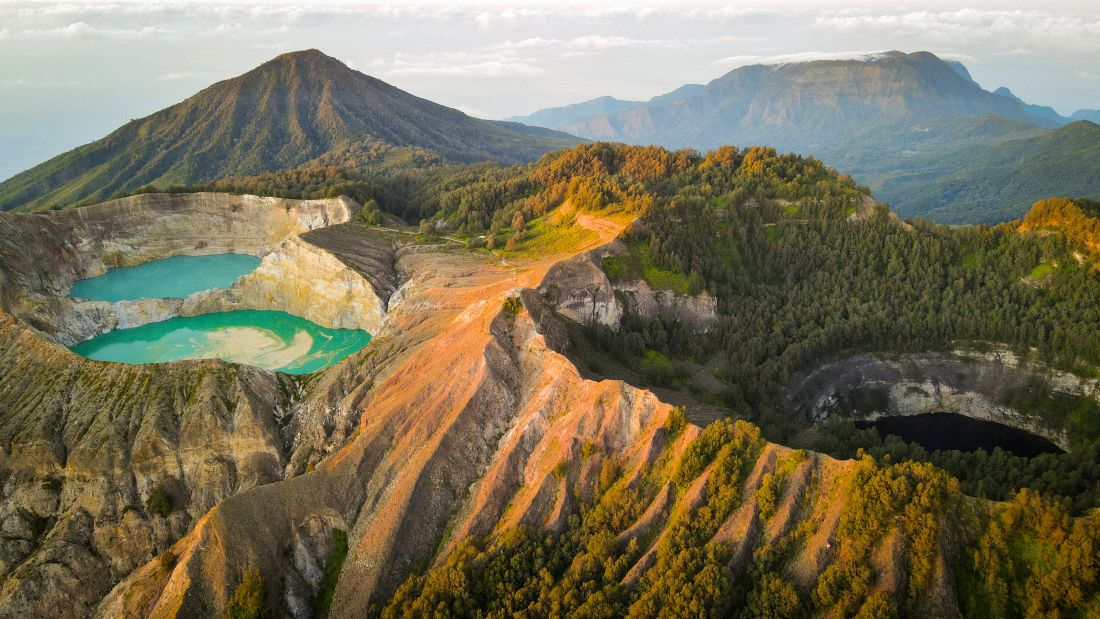
The spectacular tri-coloured lakes of Mount Kelimutu on Flores Island

From there, it's a short transfer to the harbour, where your small-ship adventure begins. You can also spend a night in Labuan Bajo before setting sail, giving yourself some time between flights and a chance to enjoy a sunset dinner overlooking the water. 

With voyages ranging from four or five days to longer Indonesian expeditions, Komodo works equally well as a standalone adventure, an extension to a Bali holiday or part of a bigger journey across the archipelago.

Meet the famous Komodo dragons in the wild

No visit to Komodo would be complete without seeing its most famous residents. Komodo National Park has been a UNESCO World Heritage Site since 1991 and is home to the world's largest living lizard. 

Fun fact:

Komodo dragons can grow to around three metres long, making an encounter with one in the wild quite an experience.

You'll explore on foot with a local park ranger, who knows the terrain best and where dragons are most commonly spotted. On Rinca Island, guided walks range from shorter circuits of around 30 minutes to longer walks of up to two hours. Along the way, you might also encounter deer, wild buffalo and monkeys. 

What often surprises visitors is the landscape itself. Rather than the lush tropical jungle you might expect, much of Komodo is covered in open savannah, golden grassy hills and rugged coastlines. It offers excellent walking views, especially with its surrounding turquoise waters.


Hike to some of Indonesia's most spectacular viewpoints

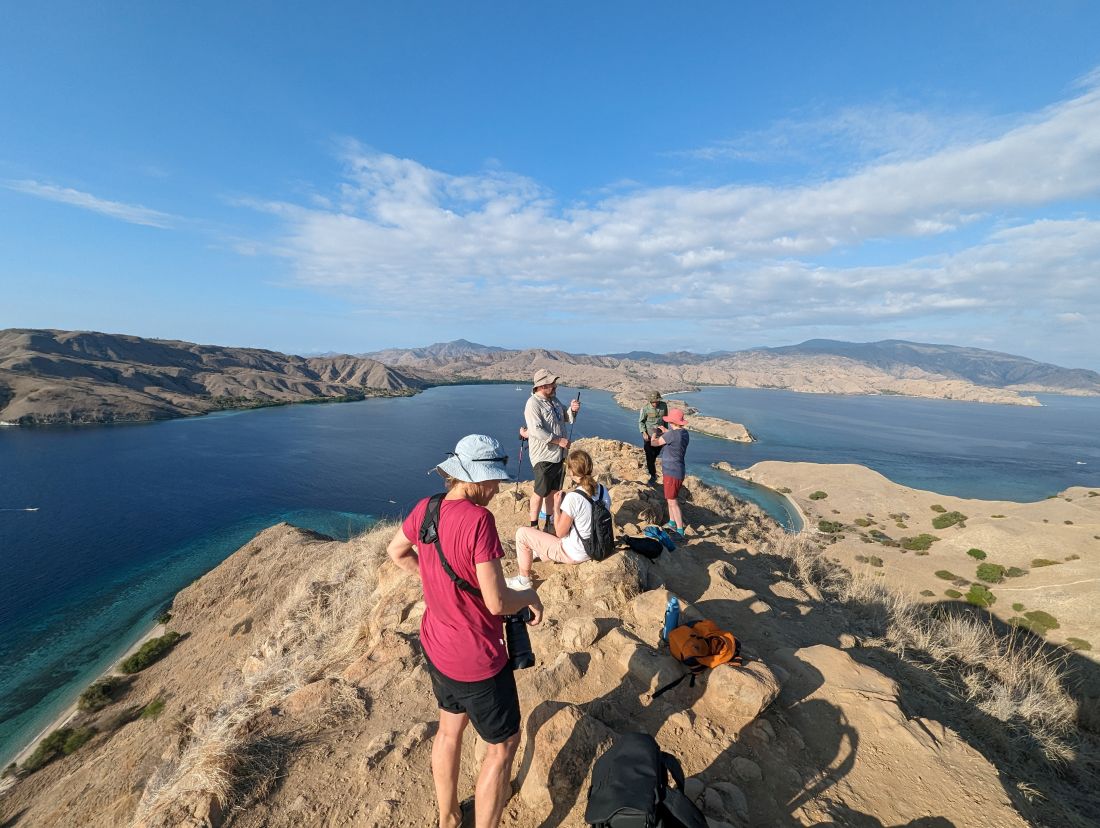
Padar Island is iconic for its sweeping views across three curved bays. Setting off early, you'll follow a trail up the island's grassy slopes to a scenic point overlooking the surrounding coastline. It's a climb worth making, particularly in the softer morning light. 

From above, you'll see the distinctive bays and beaches that have made Padar one of Indonesia's most photographed landscapes. 
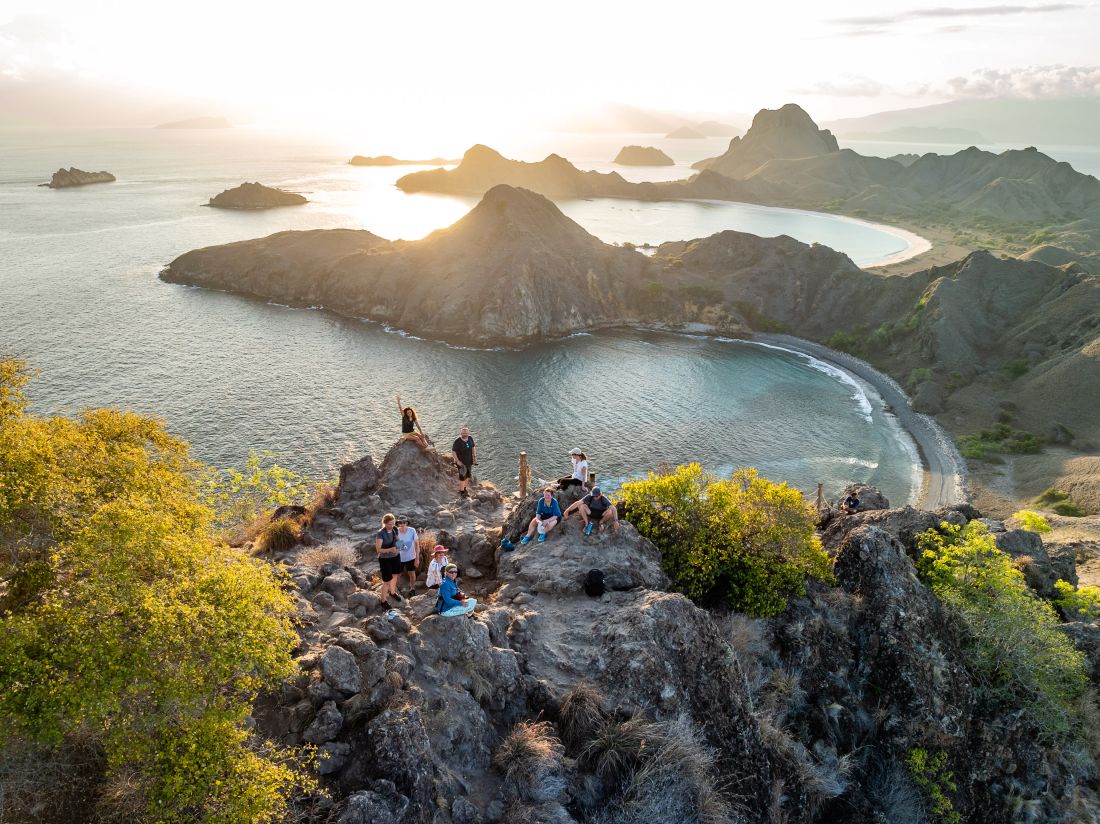
Hike the Komodo Islands |  Daniela Tommasi Photography

Depending on your voyage, there may also be opportunities to explore Kelor Island, where a short climb rewards you with views across the archipelago, or hike on Gili Lawa as the sun rises over the surrounding islands. 

The beauty of exploring Komodo by small ship is being able to combine these walks with time to cool off in the water afterwards.

Top snorkelling spots in Komodo

While the dragons attract plenty of attention on land, there's just as much happening beneath the water. Komodo's waters teem with marine life, from colourful coral and tropical fish to sea turtles and manta rays.

With a small ship as your base, you often have the chance to jump in the water more than once a day and explore different reefs and beaches. Water temperatures are generally warm and inviting, making this a destination where you'll want to keep your mask and fins close by.
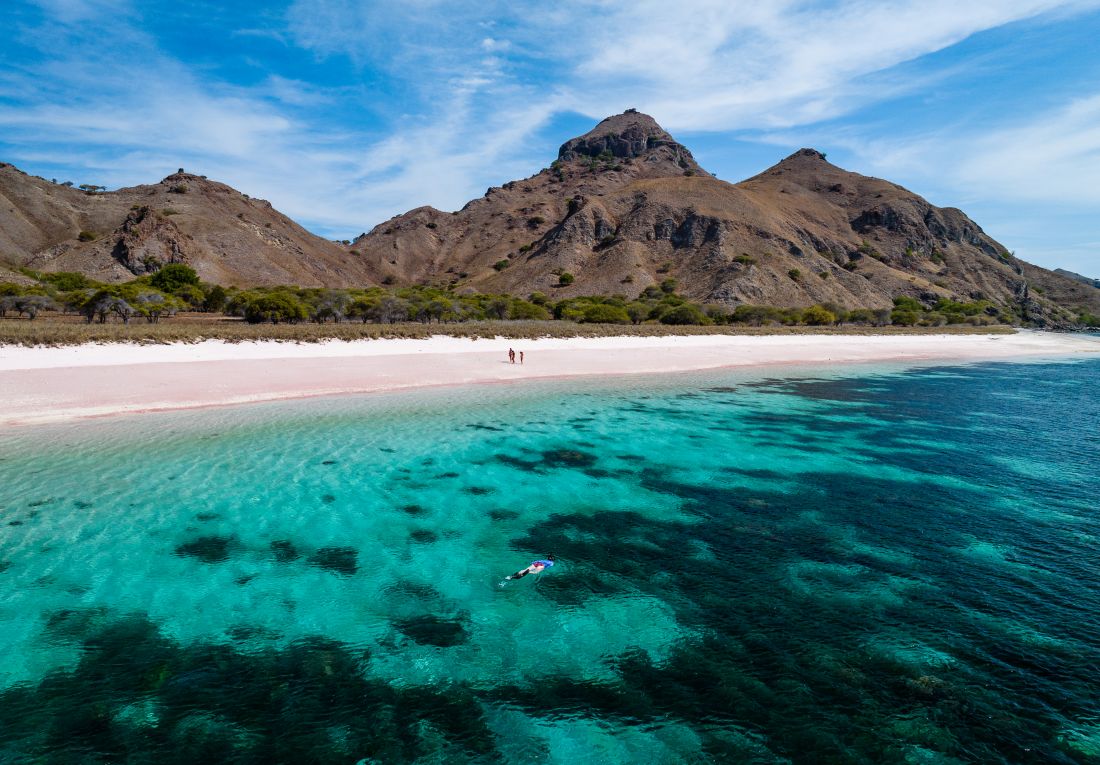
The spectacular beaches around Komodo Island |  Daniela Tommasi Photography

Some highlights include:

  • Manta Point and Makassar Reef: Known for reef manta rays that visit cleaning stations, where smaller fish remove parasites from their bodies. When conditions allow, you can snorkel alongside these graceful creatures.

  • Turtle City, Siaba Island: This shallow coral garden is where you can regularly spot green and hawksbill turtles.

  • Taka Makassar: A beautiful crescent-shaped sandbank surrounded by shallow turquoise water.

  • Pink Beach: One of Komodo's distinctive beaches, where fragments of red coral give the sand its pinkish colour. The surrounding reefs also offer excellent snorkelling opportunities.

For certified divers, some voyages also include diving. Dive sites and suitability will depend on experience and local conditions. 
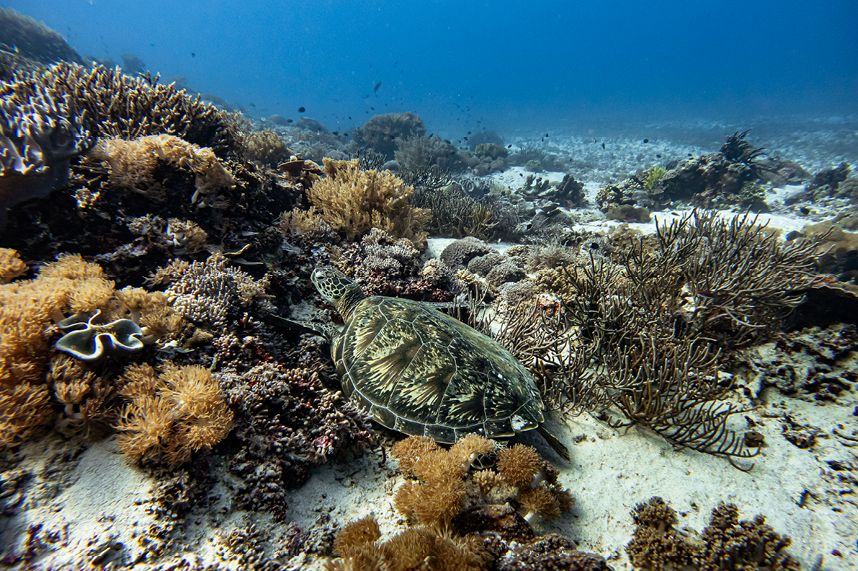
The diverse marine life around Komodo Island |  Daniela Tommasi Photography

Explore the coastline by kayak

Seeing these islands from water level brings about a whole different experience. Slipping into a kayak and paddling through quieter coastlines larger vessels can't reach is a beautiful way to take in the scenery and explore at your own pace.
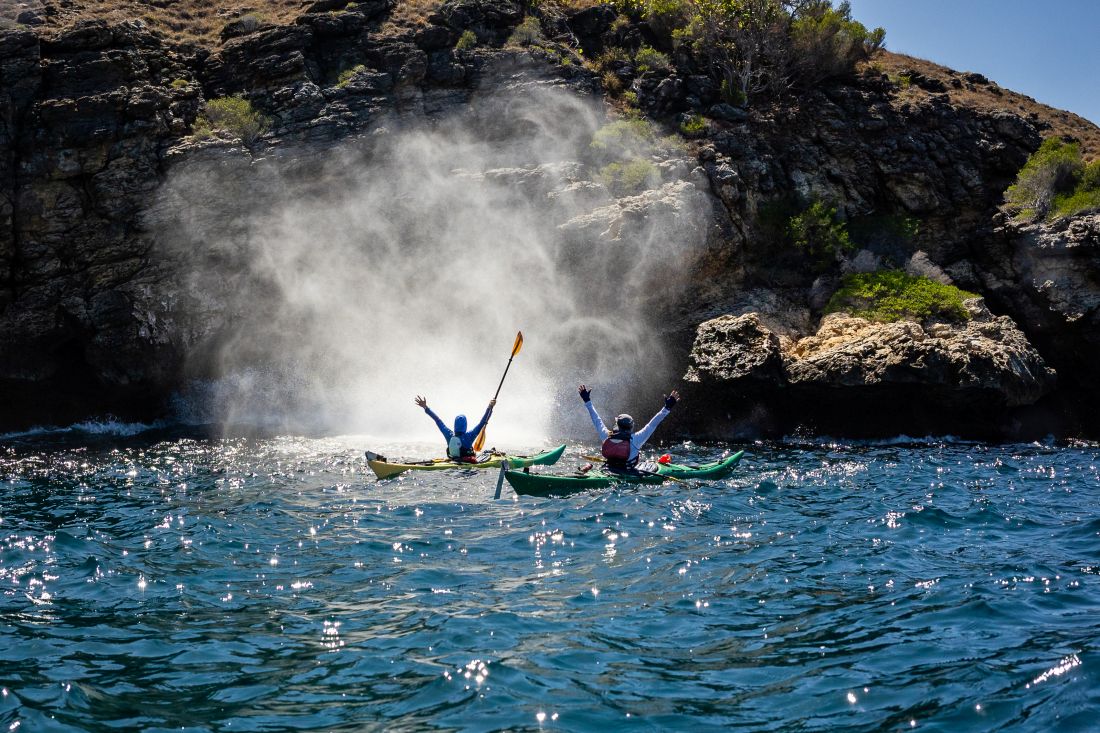
Kayak the Komodo Islands |  Daniela Tommasi Photography

For travellers who particularly enjoy paddling, our Komodo Kayak, Hike & Snorkel expedition takes things a little further. Kayaking becomes a central part of the adventure, with opportunities to paddle around Rinca, Padar and Komodo, alongside snorkelling excursions and island walks. 

With a dedicated kayak guide, it's a more active way to explore the national park on an intimate trip aboard a vessel with a maximum of 18 passengers.

Kayak the Komodo Islands |  Daniela Tommasi Photography Kayaking in mangroves around Komodo island |  Daniela Tommasi Photography Kayaking in the Komodo Islands |  Daniela Tommasi Photography
 

Witness thousands of flying foxes take flight at sunset

As evening approaches, boats often gather near Kalong Island for one of the region's most fascinating natural spectacles. Thousands of flying foxes emerge from the mangroves and stream across the sky, heading towards Flores to feed. 

Find yourself a comfortable spot on deck and watch as the sun sets and the sky fills with bats. It's a wonderful way to finish a day of exploring.

Travelling aboard a traditional phinisi

Part of what makes exploring Komodo so memorable is also the journey itself. Many of our Indonesian voyages travel aboard a phinisi, a traditional wooden sailing vessel that reflects generations of Indonesian boatbuilding heritage. Today, these beautifully crafted vessels combine traditional character with the comforts of small-ship travel. 

RELATED: What makes travelling on a phinisi sailboat so special

Depending on your voyage, you can look forward to comfortable cabins, inviting communal spaces and open decks where you can relax between activities. 
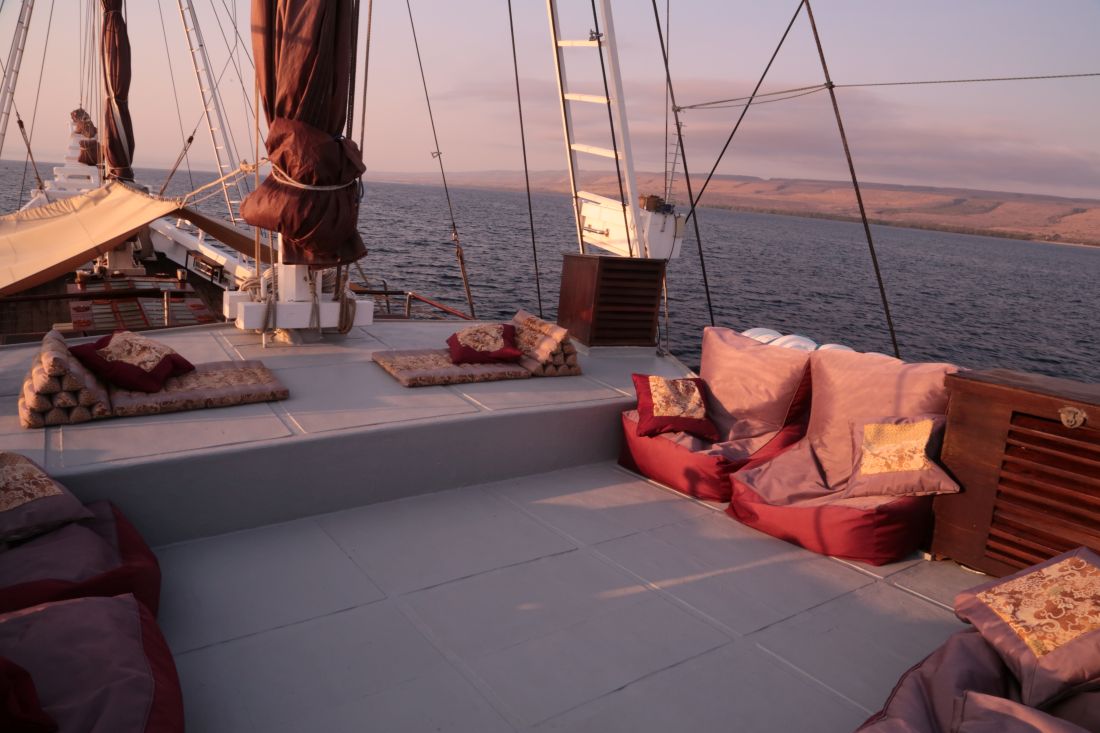
Top deck lounge area aboard Katharina

With smaller groups on board, you have more opportunities to form friendships and enjoy the quieter moments of the journey. And because your accommodation travels with you, there's no need to keep packing and unpacking as you move between islands. One day you're waking up beside a secluded beach; the next, you're heading out for an early morning walk or slipping into the water to explore another reef.
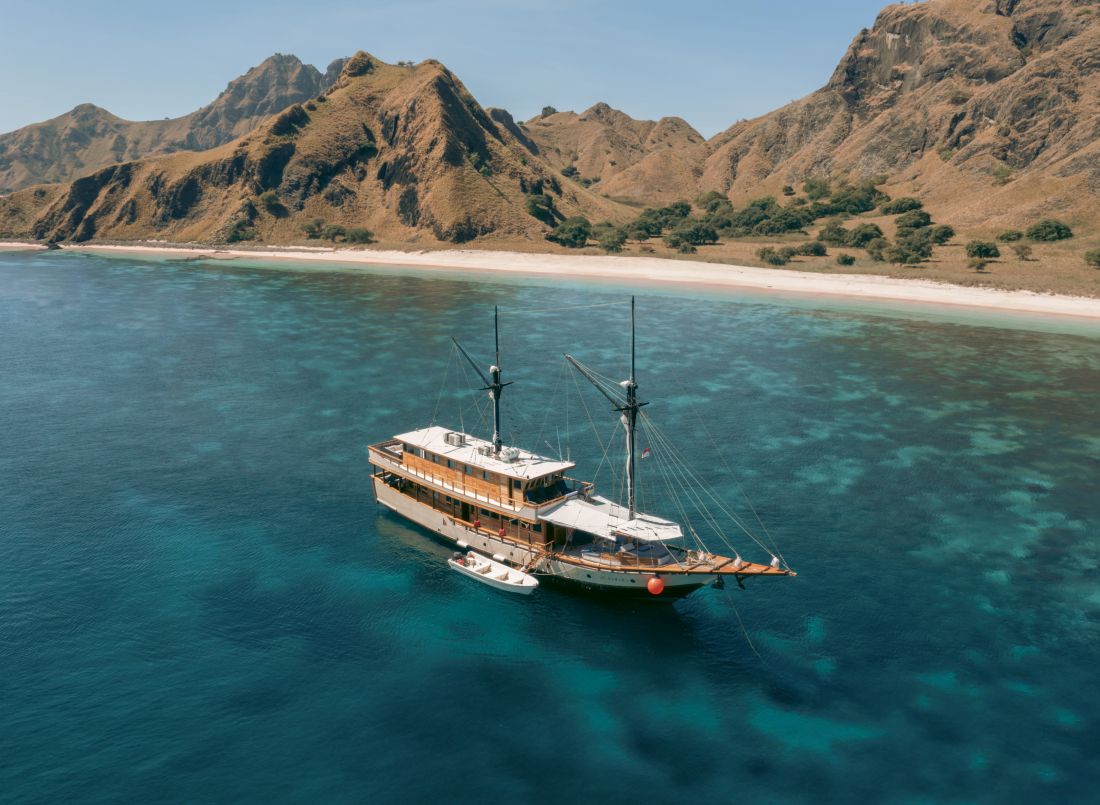
Samara 1 in Komodo

Discover the people and traditions of Flores

Outside the national park, some of our longer voyages also introduce you to the communities and traditions of the neighbouring Indonesian islands. Flores has a rich cultural heritage, where traditional customs, crafts and performances remain an important part of local village life. 

Depending on your itinerary, you may visit local fishing communities or experience the Caci, a traditional ceremonial whip-fighting performance associated with the Manggarai people of Flores.

These visits provide a unique way to learn more about the people who call these islands home.

When is the best time to visit the Komodo Islands?

Komodo has a tropical climate, with a distinct wet and dry season. The drier months generally run from around April to October, with June to September typically experiencing the driest conditions. The wetter season usually falls between December and March. 
Hike the Komodo Islands

Our Komodo departures generally operate between April and October, when conditions are more favourable for exploring the islands on foot and by water. 

As with any marine destination, snorkelling, kayaking and other activities are always subject to local weather and sea conditions.

Which Komodo Islands expedition is right for you?

You can explore a range of expeditions available, from short escapes focused on Komodo National Park to longer journeys that take you deeper into Indonesia's remarkable archipelago.

There are a number of Komodo adventures to suit various interests:

Travel Style Duration Recommended Voyage & Highlights
Short on time? 4–5 days Komodo Island Escape: See Komodo dragons, hike Padar Island, snorkel colourful reefs and watch flying foxes at sunset. Also a great option as an add-on to Bali.
Love even more activity? 9 days Komodo Kayak, Hike & Snorkel: Explore the islands by kayak, snorkel vibrant reefs and enjoy multiple guided walks with a small group.
Want to explore further? 9 days Komodo Dragons, Whale Sharks & Coral Reefs: Discover volcanic landscapes, local villages, coral reefs and the chance to swim with whale sharks.
Have more time? 13–18 days Orangutans & Dragons and other extended voyages: Combine Komodo with Borneo or other Indonesian islands for more wildlife, culture and exploration.

Incredible marine life and the chance to experience a different side of Indonesia await. While you may come for the dragons, you'll want to stay for the incredible island scenery and vibrant local culture.

Discover our range of Komodo Island expeditions → 


Indonesia’s remote islands of spice, science and rare species

This article is a snippet from the Traveller article written by Nick O'Malley.

From above, Ternate is a mere pinprick in the more than 1000-island strong Indonesian archipelago of Maluku. But, in its own way, this place has helped shape the world as we know it today. The aroma of nutmeg and cloves here has been largely replaced by the exhaust fumes of countless motor scooters, but the precious spices still grow in the island’s forests – spices that enticed Arab, Persian and Indian traders to this remote part of the world more than a thousand years ago.

Where history, wildlife and wild reefs collide

I find myself in Ternate, 3347 kilometres east of Jakarta, as a guest aboard a 14-day, 13-night adventure cruise dubbed “Maluku & Sulawesi: Rare Species, Cultures & Corals”. 

I’m sailing aboard Ombak Putih, a 42-metre twin-masted schooner or phinisi, as the traditional coastal traders of seafaring Sulawesi, Indonesia’s fourth-largest island, are known. The vessel comfortably accommodates 24 passengers in 12 en-suite cabins, all of which are, thankfully, equipped with air-conditioning.

Back on the island, an abundance of spices isn’t this region’s only claim to notoriety. There are those who believe that the greatest single idea ever to have fizzed into a human mind was first described in a little house on a side street of Ternate, the island’s small but seething eponymous city.

It was in 1858, inside a building that today houses a pet shop, that Alfred Russel Wallace, a self-taught Welsh naturalist, wrote his famous 1858 essay on evolution by natural selection. Wallace laid out his theory that earthly species evolved into their glorious variety via a competitive mechanism he called the “natural means of selection”.

He was at the time four years into an eight-year scientific expedition across the waters in which the Ombak Putih is sailing. Of course, the same theory had occurred to Charles Darwin 20 years earlier, after his celebrated voyage on HMS Beagle. But Darwin – doubtless concerned he may have inadvertently challenged the existence of a god responsible for the creation of all creatures great and small – had conveyed his theory only to trusted confidants, consigning his notes to a desk drawer.

Still intending to publish, Darwin was appalled to receive what became known as the “Letter from Ternate” from Wallace, detailing the same theory in startling detail. Nonetheless, Darwin bundled Wallace’s essay with sections of his own treatise and had the papers published together, effectively rendering the pair co-discoverers. What was at first known as the Darwin-Wallace theory of evolution drew little attention for a time, but it would come to upend the world’s understanding of science and nature, botany and biology, of philosophy and religion.

The Ombak Putih’s passengers are treated to an esteemed guest lecturer, namely Dr George Beccaloni, a former curator at London’s Natural History Museum and one of the world’s leading authorities on Wallace. 

Our two-week voyage around the Molucca Sea will include visits to the islands that shaped Wallace’s work. 

Exploring the Molucca Sea

My fellow passengers skew adventurous by demeanour and older by years. We come to know each other well over communal meals of curries, fresh fish and fruit on deck over the coming days. It doesn’t take long for those days to take on a grand sort of rhythm. The longer stretches of the cruise are made overnight, with guests waking on most mornings over new reefs to explore.

Remarkably, and especially by comparison to the sections of our own Great Barrier Reef which I have visited over recent years, the coral here is in spectacular health. And while the reefs at first blur, one into another, after enough time in the water you realise each is different. One afternoon we swim a half-moon formation around a tiny island where all I see is thriving life, but Dr George – whose greatest enthusiasm beyond Wallace is Indonesia’s reefs – points out sections cloaked in algal growth.

This is evidence, he explains, that the fish that would normally clean it have fallen in number. It’s then that I notice that the shoals we swim among are numerous but tiny. Anything big enough to make a meal has already been eaten.

One day we roll off the side of the rigid inflatable boats (RIBs) into a sanctuary for giant clams, their great fat lips spilling vivid blue and green over metre-long shells. Our tour leaders, Dion Luas and Tinae Ringo, constantly patrol for creatures that might delight. One will find, say, a seahorse or a moray eel and a yell will rise from the water and we’ll all form an earnest aquatic huddle.

A few mornings later and in the darkness a little after 4am, half our ship’s party bundle into the RIBs and head to shore, the passengers locked into a tired silence as the faces of the boat pilots glow red from the essential navigation lights. The plan is to trek into the foothills of the Sibela Mountains in time to see birds of paradise perform their courting ritual at dawn. These birds were important to Wallace. He noted they existed on the eastern side of what we know today as the “Wallace Line” – the boundary he first identified in 1859 that divides the flora and fauna of Australasia and Asia.


To the east you find tree kangaroos, cockatoos and birds of paradise; to the west, tigers and primates. Something, he realised, had caused life to evolve differently on either side of the divide. He could not have known this was the product of the ancient collision of two tectonic plates, but he was the first to note the effect. It would not be until the 1960s that the cause – continental drift – was properly understood.

Words by Nick O'Malley, who travelled as a guest of On Water Expeditions. Read his full experience.

HOW TO EXPERIENCE IT

→ 14-day adventure cruise aboard Ombak Putih

INCLUSIONS:

  • 13 nights twin share cabin accommodation aboard an intimate 24-guest sharing traditional Indonesian sailing boat
  • 13 breakfasts, 13 lunches and 13 dinners 
  • Park entrance fees and boat levies 
  • Snorkelling equipment 
  • Use of kayaks and paddle boards 
  • Local, passionate guide and expertly trained crew 
  • Airport transfers
     
Ombak Putih with her sails up |  Rachel Imber
 
 
A first-timer's guide to kayaking in Palau

If you've ever thought, "I'd love to go, but I'm not a kayaker," let's paddle those concerns away. 

It's a common question we get asked about our expedition to Palau, and the answer is reassuring: you don't need previous kayaking experience. 

Here's a simple guide to help you set the right expectations and feel prepared, so you have the confidence to explore one of the world's most pristine island archipelagos by kayak. 

Do I need to be especially fit? 

A reasonable level of general fitness helps, but you don't need to be an athlete. It's comparable to brisk walking or cycling, so if you can manage either, you can manage gentle kayaking. 

It does help if you've paddled before, but it's not the be-all and end-all.

Palau is an idyllic paradise for nature lovers |  Mac

What you'll find during your week in Palau is that your time in the water is flexible, with the pace set by you. So the activities can scale to what you want to take on. You can embark on long paddles when you're feeling energised or swap the kayak for a snorkel or swim, and you will be supported at every point in between. 

If you haven't paddled in a while, a bit of practice beforehand, such as swimming, will make the week more enjoyable. 

Will there be a practice session?

Your first day starts with a relaxed briefing on land, some kayak fitting and a short practice paddle in calm water before setting off. Most guests paddle in stable double kayaks, which is exactly what we'd recommend for a first-timer. It makes it easier to share the effort and navigation, while also enjoying the journey with a friend.

You don't need perfect technique, just a sense of adventure and a willingness to give it a go. So if you can manage a paddle stroke and you're comfortable being on the water, you'll be fine.

Kayaking crystal waters

What if I'd rather snorkel than paddle all day?

That's completely fine, and it's one of the best things about how these trips are run. If a long kayak isn't your thing on a given day, the tender can take you straight to a snorkelling spot and bring you back to the boat later. Every kayak comes with snorkel gear, so if we pass a spot that looks good, you have the opportunity to stop and get in the water.

So if you'd rather do a shorter paddle and spend the rest of the time reading on deck, that's also welcome. 

Exploring Palau aboard a small adventure boat |  Pam Dewar

How far do you actually paddle?

A typical day works out to around four to six hours in the kayak, split across two outings, and can cover somewhere between 12 and 18 kilometres. While that may sound like a lot in writing, in practice, you'll find the water is generally calm and there is always a tender nearby. So if you wanted to stop, you stopped. If you wanted to keep going, you kept going. Nobody is locked into finishing a set distance.

Paddling turqoise waters in Palau |  Mac Paddling turqoise waters in Palau |  Mac Enjoy plenty of activities and inclusions on a fully supported expedition in Palau |  Mac Enjoy plenty of activities and inclusions on a fully supported expedition in Palau |  Mac Witness incredible marine life deep in the waters of Palau |  Mac Enjoy plenty of activities and inclusions on a fully supported expedition in Palau |  Mac
 

Is it safe if I'm not a strong swimmer?

You should be comfortable in the water and able to swim, though you generally don't need to be a super-strong or fast swimmer. Life jackets are available, and something people don't always think to ask about are the inflatable noodles. If you're not confident swimming around for long stretches, you can hang on to a noodle and just drift with the current alongside everyone else. 

What's a typical day like?

A typical day might begin with an early morning kayak or snorkel session, followed by a refreshing swim before lunch back on board or on a secluded beach. In the afternoon, you could head out for another paddle, take a short bushwalk or make a cultural visit, depending on the day's plans.

A myriad of colour awaits in Palau

Each evening, your guide will gather the group for a debrief, recapping the day's highlights, sharing insights into the marine life, history and culture you've encountered, and outlining what's in store for the following day. Each day's activity is generally chalked up on a whiteboard, so you'd always know what to bring and what was ahead.

You can view a detailed itinerary on the trip page.

What should I pack for my kayaking trip?

Swimwear, reef shoes, a hat, sun protection, and a lot less than you'd think. Your shoes will most likely come off the moment you step aboard and barely go back on until you're ashore for a walk. Bring a dry bag for your camera or phone if you're taking one out on the kayak. With a bulk of the inclusion covered in our Palau Kayak, Snorkel & Dive trip, you won't have much to worry about once you set sail.

If I'd like to do some diving, do I need a licence?

Yes, if you want to scuba dive, you do need to be qualified. Our Palau expeditions do not offer learn-to-dive courses, and you'll need to bring proof of your certification, dive insurance, and a record of your recent dives before you're allowed in the water with a tank. 

Encounter diverse marine corals on the many reefs of Palau's islands |  Maddison Toddman

But diving is not the only way to see what's below the stunning surface of the Palau islands. Free diving is an option on some sites, and can be shallower than expected. And you will still be able to see plenty when snorkelling around the surface.

Witness incredible marine life deep in the waters of Palau |  Mac

What are the cabins like aboard Palau Siren?

The Palau Siren ship has eight comfortable double-occupancy cabins, accommodating up to 16 guests. Each cabin offers a choice of double or twin beds; 2 cabins are flexible double/twin. All cabins have individually controlled air conditioning and ensuite bathrooms with hot water.

Palau Siren - Fixed Double Cabin 2 The sun deck on Palau Siren Premium Twin Cabin
 

The covered outdoor dining area provides a great setting for all your meals, and the spacious air-conditioned saloon offers a cocktail bar, comfortable seating, and a large flat-screen TV. The saloon also has designated areas for charging and preparing your camera and video equipment.

There's no dedicated single cabin on board, but solo travellers aren't charged extra by default. Instead, you'll be matched with another traveller of the same gender for the week, and if there's no one to match you with, you get the cabin to yourself at no extra cost. If you'd simply rather guarantee your own space from the outset, a single supplement is payable.

What do I need to sort out before I arrive in Palau? 

There are a few practical bits worth knowing. Most nationalities, including Australians, can get a 30-day visa on arrival at Palau's airport. You'll need to complete an online Palau Entry Form up to 72 hours prior to arrival. 

On arrival, everyone signs the Palau Pledge, stamped straight into your passport — a commitment to protect the environment and respect local traditions during your stay. 

When you leave, there's a departure tax and an environmental fee to budget for, on top of an online entry form you complete before you arrive. None of it is complicated, just worth knowing about in advance. 

Always check the Palau government website and Palau Visitor’s Authority website for the most up-to-date visa and arrival information, as entry and exit conditions can change. 


If you're on the fence about whether you're "the kayaking type", take it from someone who wasn't sure either; Palau is about as forgiving a place as you'll find to test that out with an experienced crew to back you. So get there if you can. 

Curious about what else to expect on your expedition to Palau? Read our blog on Exploring Palau’s Hidden Waters: What you need to know.

How to take part in Indonesia's coral restoration

Home to more than 17,000 islands and some of the richest marine environments on Earth, local communities in Indonesia are working to ensure these reefs continue to thrive for generations to come.

Through a growing network of conservation partnerships, On Water Expeditions guests can learn about reef restoration directly from the people leading the work and, in some destinations, even lend a hand.

It's a unique and fulfilling way to experience these remarkable ecosystems not just as a visitor, but as a participant.

A rewarding aspects of reef restoration is meeting the communities and organisations leading the work

The importance of coral restoration

Coral reefs support an extraordinary diversity of marine life. They provide habitat for countless species, help protect coastlines and support the livelihoods of coastal communities.

Like many marine ecosystems, however, reefs face increasing pressure from climate change, pollution, unsustainable fishing practices and coastal development.

Through coral restoration programs, damaged reef systems can begin to recover. 

The amazing colours of the reef The Tomato Clownfish The incredible colours and corals of Indonesia
 

What does it involve?

The process can take many forms, but often involves growing coral fragments in underwater nurseries before transplanting them onto restoration structures or degraded reef areas where they can continue to grow.

One of the most rewarding aspects of coral restoration is meeting the communities and organisations leading the work. Travellers are increasingly becoming part of that conservation story, with the opportunity to contribute to these reef restoration efforts during their voyage.

Across Indonesia, On Water Expeditions' local partners collaborate with grassroot conservation programs, including:

  • Rinca Nursery Project in the Komodo region
  • Sinara Kaimana in Southern West Papua
  • Tompotika Foundation in Central Sulawesi
  • Coral Guardian, an international NGO with active restoration projects in Indonesia

Many voyages are also joined by marine experts whose experience includes helping establish and develop coral restoration initiatives throughout Indonesia. 

Coral restoration plays an important role in supporting reef recovery

Local conservation teams often come aboard to share their stories, explain the challenges facing local reef systems and introduce the restoration projects taking place in their region, giving travellers a more meaningful and connected experience of the regions they explore. You may even meet the founders of Ocean Gardener, who have contributed to developing coral restoration in the Bali area.

Projects can involve guests being invited to join coral planting activities in shallow water, working together in small groups. Participants would attach coral fragments to specially designed steel restoration structures under the guidance of local experts.

Once completed, the structures are carefully deployed by local restoration teams to reef sites at depths of approximately three to five metres. Those comfortable with freediving may also have the opportunity to assist with the deployment process.

Helping damaged reef systems recover through coral restoration initiatives

By learning how coral grows and understanding the role it will play in the future reef ecosystem, travellers gain a deeper appreciation of these underwater environments. 

This opens up the destination as more than just a beautiful place to snorkel, swim, kayak or dive. It gives travellers a better understanding of the living ecosystem connected to communities, marine life and the need for ongoing conservation efforts to protect it for years to come.

How do corals reproduce?

Coral may look like rock or plants, but it's actually made up of tiny living animals called polyps. They support marine life, coastal communities and entire ecosystems.

During special times of the year, many coral species release millions of tiny eggs and sperm into the ocean in a synchronised event known as mass spawning. Carried by the currents, the resulting larvae eventually settle on the reef and begin growing into new coral colonies.

Another way corals reproduce is through fragmentation. If a piece of coral breaks off and settles in a suitable location, it can continue growing into a new colony as a clone of the original coral. This process helps reefs recover naturally and is often used in restoration projects.

These methods are useful for quickly growing and repairing parts of the reef, especially after damage.

Many restoration projects help accelerate this process by growing coral fragments in underwater nurseries and transplanting them onto damaged reefs.

Supporting reef recovery through coral restoration programs

Did you know?

The Coral Triangle, which includes Indonesia, is home to around 76% of the world's known coral species, making it one of the most biologically diverse marine regions on the planet.

How small ship expeditions fit into it all

The voyages offered by On Water Expeditions integrate conservation into many of their Indonesia itineraries.

Smaller vessels can access remote communities and lesser-visited coastlines where conservation projects are often taking place. They also allow for more personal interactions with local experts, guides and community leaders.

At On Water Expeditions, we believe protecting these environments is a shared responsibility. By partnering with local operators and organisations committed to responsible tourism and low-impact exploration, we aim to leave the places we visit better than when we found them.

Travellers getting involved with coral restoration

Through coral restoration programs, travellers gain a deeper understanding of the challenges these ecosystems face and the solutions being developed on the ground. While human impact has greatly affected reef ecosystems, we also have the ability to help restore them.

What trips feature coral restoration activities?

Coral restoration activities are currently featured across a growing number of Indonesian expedition voyages.

Opportunities may be available on itineraries visiting:

Komodo National Park

Including voyages exploring the region's coral reefs, whale shark habitats and the islands famous for their Komodo dragons. View trip → 

An unforgettable life experience, swimming with Whale Sharks in Indonesia |  George Karbus Photography

Raja Ampat and West Papua

Including expeditions between Sorong and Kaimana, where some of Indonesia's most biodiverse marine ecosystems can be found. View trips → 

Snorkelling the pristine coral gardens of Raja Ampat

Central Sulawesi

These journeys combine remote island exploration, marine wildlife and vibrant coral environments. View trips → 

Kayaking the undiscovered islands around Sulawesi

The opportunity to engage with local conservation communities working to protect it while surrounded by some of the world's most spectacular seascapes, is a highly rewarding experience.

Why join a coral restoration experience?

  • Learn from local conservation leaders and marine experts
  • Develop a deeper understanding of Indonesia's reef ecosystems
  • Participate in hands-on coral planting activities
  • Support grassroots community restoration initiatives
  • Experience marine conservation as part of your expedition journey

For many guests, the connection continues long after the voyage ends, allowing them to follow the progress of restoration projects and support the communities behind them.

Like many of the best moments in travel, the impact is often found in the smallest details: the opportunity to leave with a deeper understanding of the ocean and your place within it.

Sometimes that's where lasting conservation begins.

Snorkelling the Maldives: 5 wildlife encounters you can only have from a small boat

The sun is barely up, the water is glass-like, and you're the only boat in the bay. You notice nurse sharks beneath and schools of fish swimming in circles. There are no other engines humming in the distance because your captain planned for exactly this tide, in exactly this spot, long before you woke up.

This is the beauty of a small ship expedition through the Maldives, curated for guests who want more from the water than just a view of it.

So if you love jumping into the water, here are five incredible snorkelling moments you can experience when travelling on a dhoni.

Manta rays gliding past the zodiac

While some marine encounters are hard to plan for, it helps when you have a tour leader who has spent years reading the atolls or has lived the majority of their life in the water. This knowledge and access are invaluable because they'll know where mantas like to pass through. 

Our tour leader, Egan, who is an avid surfer and ocean expert, often takes guests on a zodiac to one of his favourite spots, where within minutes you could have two manta rays gliding past — slowly and completely unbothered. 

Spinner dolphin pods

There's also nothing more incredible than when nature shows up unannounced. And when your captain can detour for dolphins (and actually does!), you know you’ve made the right call joining a micro cruise. So imagine when a pod of around 200 spinner dolphins fall into pace alongside the dhoni. 

One of our travellers recalled how, in her experience, a mother and calf swam quietly together for a while before the calf broke into play, and the whole pod lifted into a display – leaping, spinning, scattering across the surface. The best part is that when aboard a small dhoni, it can position itself nearby without disturbing them.

Hawksbill and green turtles in their element

Drifting through the shallows over seagrass meadows by the house reefs, and out in deeper water around the coral atolls, you can encounter hawksbills and green turtles. With small groups of up to twelve guests, there's room to spread out so each traveller gets their own quiet moment with a turtle, rather than crowding a single animal. Across a week of sailing through multiple atolls, you start to collect more and more of these incredible snorkelling moments. 

Nurse sharks at sunrise

The idea of getting into the water with a shark is not as scary as it sounds if it's a nurse shark. These suction feeders have only two small front teeth and a vacuum, so they are considered harmless when swimming nearby. 

With the dhoni anchored overnight near a known nurse shark site, guests are able to jump in the water at sunrise — a full hour before the day-trip boats begin arriving from the islands. So by the time 30 or 40 other snorkellers are piling into zodiacs in the distance, you'd already have had the site to yourselves and are sailing on. It's often one of the most memorable encounters of the trip.

The coral ecosystem

Guided by a crew who know these atolls intimately, you'll find pockets of vivid, healthy coral. Coral gardens come alive with fish coming in every direction. There are parrotfish nipping coral heads, butterflyfish flickering past, and shimmering schools of fusiliers turning. In a small group, there is space to swim and quietly follow a school as it moves, while letting the reef carry on around you.

However, the Maldives' underwater landscape is still under pressure from coastal development, dredging, and the construction of new resort islands, and reef conditions can vary considerably from one site to the next. This is why our dhoni crew treat the itinerary as a starting point rather than a fixed schedule, so the reefs get a chance to recover between visits. The crew are often in the water at almost every stop, actively photographing coral and monitoring its condition, with the flexibility to reroute and rotate between sites when needed.  

Why the small ship difference matters:

  • Guests are first in the water. While day-trip boats run on schedule, the dhoni can anchor overnight near the next morning's wildlife and is in the water before anyone else arrives. This can mean On Water Expeditions guests are often the only people snorkelling at a given site — a rarity in a country that sees more than a million visitors a year.
  • More time for activities. On a dhoni expedition, the vessel is your basecamp with the beauty of waking up somewhere new each day. Snorkelling, sandbar landings, beach barbecues, and visits to local island communities are part of the voyage rather than short side trips — giving you more time to experience the islands, above and below the water.
  • Snorkelling is tailored to the group. Confident swimmers can head out with a guide to deeper sites, while less experienced snorkellers stay closer in with the crew among calmer water. With a handful of guests on board, there is a greater level of personalisation.
  • The route flexes around reef health and wildlife sightings. Itineraries are flexible, allowing the crew to assess coral condition and rotate between sites to avoid overworking any one reef. This is part of On Water Expeditions' commitment to low-impact and sustainable travel.

With no more than 12 passengers and fresh onboard meals cooked by your personal chef, joining a Maldives Dhoni voyage is a truly intimate way to experience the islands, where adventure is built into every journey. View the itinerary → 

Why you should spend a night in Malé, Maldives before you sail

Malé may be one of the world's smallest capitals, but it packs more life into a square kilometre than most cities manage in ten. There are mosques between apartment blocks and mopeds threading between mopeds. 

The first thing you'll notice is the call to prayer. It carries across rooftops and over the harbour five times a day, layered from a dozen mosques at slightly different beats so it feels less like one announcement and more like the city breathing. After a long-haul flight, it lands as a kind of beautiful sensory overload. 

But the city is no Honolulu; it's a working capital with its own rhythm, and spending a night here shows a side of the Maldives a rushed day transfer won't.

How to spend your evening in Malé

Spending a night here before you set sail on a traditional dhoni, you'll find a city of culture, flavour, and a story worth knowing before the islands take over.

When the heat softens in the late afternoon, exploring the city on foot is a great way to take in the sights. The island is so small you can actually walk across it in less than an hour.

Head over to the old fish markets, where the day's tuna comes off the boats whole. Visit surrounding local produce markets, which lay out a sprawling mix of dried fish, palm sugar, chillies, breadfruit, and fruit from the outer atolls. Fresh mango, anyone?

The cultural orientation and genuine hustle are not to be missed.

Stop by Sultan Park for a quiet green pocket near the National Museum and the Old Friday Mosque before strolling to the waterfront at sunset, which is where a lot of the city's life ends up most evenings. 

If you want a meal in town, the Maldivian kitchen leans closer to Sri Lankan than Indian — thinner curries, coconut-rich, fiery in unexpected places, with reef fish at the centre. 

A few things to know about the Maldives culture 

It's also important to note that the Maldives is a strict Muslim country where standards of dress and behaviour are conservative, and you'll notice that in Malé in a way you won't on a resort island.

Some things to note for the city: 

  • Dress modestly: shoulders and knees covered, for both men and women. Light cotton works for the heat. 
  • Public displays of affection are not tolerated.
  • There is no alcohol on Malé. However, tourist resorts and tourist boats are licensed exceptions; the local islands are not. 
  • Friday is the main day of worship; some shops and offices close for part of it. 
  • Photographing people without asking is poor form, especially inside markets and mosques.

Where to stay

Mid-range hotels are available in Malé or in Hulhumalé, if you prefer staying near the airport. Look for something walkable to the markets and waterfront. 

What to wear in town

Modest, light layers — shoulders and knees covered. Slides or sandals. A small daypack. 

Currency

Carry some Maldivian rufiyaa for street eats and markets. US dollars are widely accepted at tourist-oriented establishments. 

Before you set sail to the islands of the Maldives, spend a night in town. Trying to squeeze Malé into the same day as your boat boarding. It's the rush that makes people miss the point of the place. 

Frequently Asked Questions 


Is it safe to walk around Malé at night?

Yes. Malé is a very safe city by global standards. The usual common sense applies — keep an eye on your bag in crowded markets, dress modestly — but violent crime is rare, and the streets are busy until late. 

How big is Malé?

The whole island of Malé is roughly 8.3 square kilometres (3.2 sq mi) and is among the most densely populated capital cities in the world, as roughly a third of the country's population lives here for work and education.

Can I drink alcohol in Malé?

No. Alcohol is not sold or served on Malé or any inhabited local island. It's available at licensed resorts and on licensed tourist vessels (including our Dhonis), but not in the capital itself. 

How long do I need in Malé?

A night in Male is a good start for most travellers. It gives you time to settle in, especially if coming off a long-haul flight and still take in the city on foot in the evening. Two nights' stay works if you want a slower-paced itinerary or are stitching the trip into a longer regional itinerary. 

See our Maldives Dhoni voyage, which begins with a night in Malé. On Water Expeditions dhoni guests enjoy a guided walking tour as part of the itinerary, and the next morning, a transfer to the boat runs, so you're on the water early.  

Best Hidden Snorkelling Spots in Indonesia's Raja Ampat

Raja Ampat is a haven for snorkellers. Everywhere you look, there’s a whole world under the water. Located in the Coral Triangle of Southeast Asia, the area boasts some of the most biodiverse marine life and coral reefs. It is widely considered one of the best snorkelling destinations in Indonesia, and arguably in the world.

If you dream of going snorkelling in Raja Ampat, here are some of the best underwater spots you can go to.

The incredible corals of Indonesia Hiding in my home Hawksbill Sea Turtle, Raja Ampat Stingless jellyfish, Raja Ampat Snorkel with Manta Rays in Raja Ampat The diversity and colour of the 'Coral Triangle' The vibrant waters of Raja Ampat |  Rachel Imber
 

Snorkelling in Yenbuba 

Visiting Yenbuba is like stepping into another world. Living up to its nickname, the Fishbowl, this spot is like a giant bowl filled with colourful fish. There are so many species of fish, from the small ones to the big ones. You can float there peacefully, surrounded by these amazing underwater creatures.

Swimming in Kapatcol

The snorkelling site of Kapatcol is a fantastic playground for underwater photographers. Colourful corals grow everywhere, from the shallows to the deep areas, where you can find groups of fusiliers, silversides, and sometimes moray eels outside of their dens. 

Hiriuli below the surface

Hiriuli is a perfect place for beach time where you can relax under the warm sunlight or enjoy a nice beach party. But the most fascinating part is the underwater world around the area. Once you jump into the water, you will encounter tons of fish swimming around in all sorts of colours, making it like a real-life underwater party. 

...

What marine life can you encounter snorkelling in Raja Ampat

Once you jump into the water, be prepared to encounter lots of marine species. Below Raja Ampat’s water surface lies 75% of the world’s coral species, 13 marine mammal species, 5 of 7 sea turtle species, and over 1000 fish species. 

The moment you plunge into the water, you’ll always be able to float on the water’s surface, surrounded by a school of colourful fish. 

If you’re lucky, you can encounter iconic species like Manta Rays, Whale Sharks, Sea Turtles, and rare sightings like the Epaulette Shark. 

A majestic Manta Ray

What to bring when snorkelling in Raja Ampat 

When you join an active Indonesia cruise with On Water Expeditions, you don’t have to rent or bring your snorkelling gear as everything you need for the activity is provided, including snorkelling masks and fins in various sizes for you to pick.

Apart from the snorkelling equipment, make sure to pack:

  • Reef-safe sunscreen: Once you go snorkelling, you will spend a lot of time in the sun. Using sunscreen will help protect your skin from sunburn. Make sure you use reef-safe sunscreen so you can enjoy snorkelling without harming the corals. If you don’t have one, there is no need to worry, because we also provide reef-safe sunscreen on the boat. 
  • Swimwear: Pack your comfortable swimwear. You can bring more than one, so you have an extra while waiting for the other one to dry. 
  • Camera gear: Raja Ampat is heaven for underwater photographer enthusiasts. You might want to document all your experiences and the beautiful things you find under the water surface of Raja Ampat, so pack some underwater or waterproof cases to capture the stunning marine life.

Best time to snorkel in Raja Ampat 

Every place in Raja Ampat is available for visiting all year round, but the best time to snorkel in Raja Ampat is during the dry season, from October to January. 

During this time, you will enjoy the best conditions for snorkelling in Raja Ampat, with calm water, clear visibility, and comfortable, warm water temperatures, making your snorkelling adventure even more enjoyable. 


Choosing the best snorkelling cruise in Raja Ampat

If you want to explore the true underwater beauty of Raja Ampat, the best way is by joining a liveaboard snorkelling cruise. This floating hotel offers comfortable accommodations and provides access to the hidden gems of Raja Ampat. 

Discover a range of Raja Ampat snorkelling adventures aboard our traditional wooden phinisi ship. Our all-Indonesian crew will guide you to the best snorkelling sites and provide you the best experience onboard. Our tour leaders are knowledgeable snorkelling experts who can show and introduce you to all the marine life you can find under the surface.

Also, if you are a beginner, they are always happy to give you a free snorkelling lesson and will make sure you feel comfortable in the water. 

Planning to explore Indonesia's remote islands? Join an all-inclusive active expedition today → 


Words by Abd. Wahab 

Snorkelling Techniques & Safety: A Beginner's Guide

Snorkelling offers far more than just a glimpse of the underwater world. It’s an invitation to reconnect with nature, to float in serenity while the marine life unfolds around you in dazzling colour and form.

With On Water Expeditions, each snorkelling journey becomes part of a larger adventure, whether that's sailing through Indonesia's incredible archipelago of islands, meeting local communities and exploring a marine paradise few experience. 

If you're looking to connect with the marine world, snorkelling is an accessible and rewarding activity that requires no prior experience apart from being a competent swimmer; basic water confidence also helps. It welcomes explorers of all ages and fitness levels.

Snorkelling equipment 

Unlike scuba diving, which involves air tanks and deeper descents, snorkelling allows you to breathe naturally through a snorkel tube while staying buoyant at the surface. 

The main gear needed is:

  • Mask – Provides clear vision underwater. A proper seal and comfort around the face are essential. Test it by pressing the mask to your face without the strap and inhaling slightly through your nose; it should stay in place. 
  • Snorkel – A breathing tube that allows you to inhale air while floating face down. You want to choose a snorkel with a purge valve for easy clearing and a splash guard to reduce water intake. Fins – Extend your swimming reach and efficiency. This can be optional to wear. 
  • Fins – Open-heel fins with adjustable straps are great for varied conditions (cold water may need booties). Full-foot fins work well in warm, calm waters. 
  • Optional extras – Gloves, booties, and rash guards for comfort and sun protection. 

When you sail with On Water Expeditions, all snorkelling equipment is provided onboard, which are carefully maintained and ready for use. 

Our experienced tour leaders and friendly crew guide every guest through the process of fitting, adjusting, and using the gear, ensuring your first moments in the water are comfortable, safe, and unforgettable. 

Additionally, our experienced crew aim to stop at locations with the best visibility, providing you with a greater opportunity to spot coral colonies, sea turtles, or reef fish as they go about their daily routines in the clearer blue shallows. 

The colourful world of coral Stingless jellyfish, Raja Ampat Crystal clear waters of raja Ampat The incredible colours and corals of Indonesia The electric colours of a feather star
 

What's the difference between snorkelling, scuba diving and freediving? 

Snorkelling offers freedom, lightness, and immersion without the complexity of an air tank or the need for deeper descents, like those required for scuba diving. Using a snorkel allows you to breathe through the tube and observe the underwater world from the surface while staying buoyant. This is an excellent option for beginners.

Freedivers may plunge deeper for short periods, typically with a mask, but must hold their breath as they descend below the water's surface. 

Scuba diving requires a tank of compressed air to go underwater for longer and deeper exploration. Training and certification are required (e.g. PADI Open Water) to participate in this activity.

Snorkelling techniques 

Once equipped, it’s all about relaxation and rhythm. 

  • Body position: Float horizontally, keeping your face in the water, and move slowly and smoothly. 
  • Finning: Use gentle kicks from the hips, not the knees.
  • Clearing the snorkel: A firm exhalation removes any water that enters the tube. 
  • Surface diving: Take a deep breath, tip your body downward, and glide beneath the surface for a closer look — always within safe depths. 
  • Breathing control: Slow, steady breaths help you stay calm, conserve energy, and extend your time in the water. 

With a little practice, snorkelling can easily be taken up.

Snorkelling Safety 

Our onboard crew conduct safety briefings before every snorkel session and are always in the water alongside guests, ensuring your experience is as safe as it is awe-inspiring. 

Snorkelling the pristine coral gardens of Raja Ampat


To ensure you have an enjoyable experience while respecting the environments you visit, follow these key safety and awareness guidelines: 

  • Pre-snorkelling checks: Ensure your mask seals properly, fins are secure, and the snorkel is clear. 
  • Buddy system: Always snorkel with a partner. Keep an eye on each other, especially in open water. 
  • Sun protection: Apply reef-safe sunscreen, wear a rash guard, and stay hydrated. 
  • Ocean awareness: Learn about local currents, tides, and weather conditions before entering the water. 
  • Respect marine life: Observe, don’t touch. Avoid standing on coral or chasing animals. Responsible snorkelling is essential to protect these treasures. Never touch corals, avoid kicking up sand, and give marine animals plenty of space.

By following these principles, every snorkeller becomes a steward of the sea. 

Ready to dive in? 

Snorkelling opens a world to anyone with a sense of curiosity and wonder, with no tanks or heavy equipment. So don your mask, fins, and feel the rhythm of your own breathing and experience the magic that waits just below the surface. Check out our top Indonesia trips that explore some of the best snorkelling spots →


Adapted from original words by Gavin Gallagher.

My 10 Days Sailing on a Phinisi Liveaboard in Indonesia

From the moment I stepped barefoot onto the warm timber of the phinisi, I felt a grounding sensation.

And while I thought the highlight of the trip would be the islands and reefs we were heading toward, it didn’t take long for me to realise that the boat itself would be just as much of a standout. Mainly in the way it felt, the people who sailed it, and the heritage it carries.

Turns out, I didn’t wear shoes for the rest of the trip (other than when we went for a hike or onto shore), and I’d never felt more connected to the ocean.

Spectacular Misool Island, Raja Ampat |  Rachel Imber

The feel of the boat

Walking barefoot across the sun-warmed timber, I could feel the phinisi’s character immediately. It isn’t your typical slick, modern yacht; it creaks, breathes, and shifts with the sea. 

Built by hand from Indonesian hardwoods, every joint and curve reveals knowledge passed down for generations. It makes you slow down, pay attention, and connect with the rhythm of the ocean. 

Unlike modern cruise ships that power through the water, a phinisi moves with the ocean. Its sails harness the monsoon winds, and its hull glides easily over reefs.

My cabin was comfortable, with an en-suite and all the basics, but the deck was where I lived. It was the real drawcard. It was where I'd sip my coffee at sunrise and watch the ocean light right up. 

Taking in the spectacular Raja Ampat sunset |  Rachel Imber

The people who sail it 

Most of the crew were from Sulawesi, descendants of the very boatbuilders who created our ship, and they were just incredible. Their presence reminds you that this isn’t just a boat; it’s a living culture. They bring warmth, local stories, and a level of care that goes beyond service. 

They’d even write the daily plan on a board so we knew whether to grab swimmers, cameras or reef shoes, so everything felt easy. The captain was very keen on fishing and had a licence, so while we were out having a snorkel, he would go and catch lunch – it didn't get any fresher than that! I was very impressed. 

Ultimate cocktail maker and all round good guy Made |  Rachel Imber Raising the sails |  Rachel Imber Ombak Putih with her sails up |  Rachel Imber A delicious beach lunch, Hiriuli Island |  Rachel Imber
 

Cultural moments

A place that really stayed with me was West Papua. We sailed past waterfalls tumbling straight from the jungle, visited small villages, and snorkelled coral gardens with no other boat in sight. 

During the village visits, it was really good to get that local experience and knowledge while we were out there, too, especially from the perspective of a local guide. There was even a small but meaningful impact we could have in some of the local communities we stopped by, supporting them in a simple way by buying fruit and vegetables to restock the boat.

Cheeky children Sipatnanam Village, West Papua |  Rachel Imber

The underwater world

Even though I’m not a diver, as a snorkeller, I was blown away by the beauty of the Coral Triangle. We slipped past uninhabited islands where jungle met white sand, and swam in reefs teeming with marine life and colour. You could spend three or four hours a day snorkelling and never get bored – electric corals, turtles, stingless jellyfish, and fish swimming in all directions. 

One day, we swam with whale sharks that had come to feed near traditional fishing platforms. On another day, we kayaked through mangroves looking for the Birds of Paradise.

Snorkelling in Raja Ampat |  Rachel Imber Snorkelling and relaxation on Hiriuli Island, Raja Ampat |  Rachel Imber The colourful waters of Raja Ampat |  Rachel Imber
 

The great thing about the itinerary was its flexibility. So if you prefer less activity, you could simply relax on a remote beach or just read a book on deck. There was never any pressure to join if you weren't up for it, but paddleboarding, snorkelling and hiking were available most days.

A particularly memorable moment was when dolphins came from miles off and swam directly beneath our bow. Our captain didn't hesitate and just cut the engine and slowed down, and for 15 minutes, the dolphins just rode the bow with us. It was so magical and so spontaneous, which is what life at sea should be.

...your full embed code...

Why it stays with you 

The beauty of the phinisi boat was how slow-paced each day was, making it easy to soak in the experiences and these moments in nature. It’s a journey that still lives within me long after the sails came down. Although I had gone looking for coral reefs and empty beaches, what I found was a deeper connection to Indonesian history, culture, and the sea itself.

So if you love the idea of taking your shoes off and letting the ocean reset your pace, a phinisi adventure might just be what's calling.

Words by Rachel Imber who travelled on the Papua's Birds of Paradise & Whale Sharks trip.

What makes travelling on a phinisi sailboat so special

Further east of Indonesia, you'll find jungle-covered islets that dot a remote and coral-diverse archipelago. From the water, you can best experience these islands and rich coral reefs with a phinisi boat at the heart of the experience.

A phinisi liveaboard combines traditional craftsmanship, warm Indonesian hospitality and a relaxed pace of travel with a small group.

It’s an immersive style perfect for anyone wanting to disconnect, snorkel vibrant reefs and enjoy Indonesia’s remote island landscapes from the comfort of a beautifully built wooden vessel.

What is a phinisi boat?

A phinisi (also known as 'pinisi') traces its origins to South Sulawesi, where the Bugis and Makassarese people have been master shipbuilders and sailors for generations. 

Their seafaring reputation was earned on these very vessels, which once carried spices, textiles, and stories across the archipelago and beyond. Shipbuilding remains a communal craft where entire villages come together to construct a phinisi, each piece shaped by hand using skills passed down orally.

The comfortable 'phinisi' The Jakaré in Indonesia

Phinisi boats are built almost entirely from Indonesian hardwoods, often ironwood or teak, chosen for their strength and durability. Unlike large floating cruise resorts built for mass tourism, a phinisi is designed to travel comfortably through Indonesia’s shallow reefs and island channels. 

Modern phinisi vessels combine their classic silhouette, featuring twin masts, sweeping sails, and a curved hull shape, with today’s creature comforts. 

Many are fitted out as small expedition boats with:

  • Cosy cabins - housing no more than 24 guests, some even holding fewer than 12 people.
  • Open decks for watching the water
  • Lounge and dining spaces
  • Snorkelling or kayaking gear available

UNESCO’s recognition of the phinisi as an Intangible Cultural Heritage of Humanity highlights the vessel's significance as an emblem of Indonesia’s role as a maritime crossroads.

Spectacular Wayag Island in Raja Ampat

The sailboat experience: why choose a phinisi adventure?

Sailing on a phinisi feels unhurried and connected to the environment. With small passenger numbers, with guests of 24 or fewer, the experience is intimate. The vessel becomes your base and steady guide, carrying you through a region where the ocean and local cultures are closely linked.

Enjoy time to stop for dolphin sightings, gain easy and regular access to islands fringed with reefs and beaches, experience fresh air, wooden decks, and sunrises you can watch from bed.


Because itineraries are flexible, the captain and crew can often change course for calm coves, wildlife encounters, or head to protected snorkelling sites.

Islands and reefs of the Coral Triangle

The phinisi’s natural home is the Coral Triangle, the richest marine environment on Earth. Here, the boat slips between uninhabited islands where white sand meets jungle and time seems to stand still. Beneath the waterline, coral reefs burst with colour and life, manta rays glide past, reef sharks patrol, and schools of fish shimmer like quicksilver in the current.

Phinisi boats are especially common in: 

  • Raja Ampat – part of the Coral Triangle, home to some of the richest reefs on Earth. 
  • Komodo National Park – islands, pink beaches, and manta rays. 
  • West Papua – quieter, more remote corners with dream-like seascapes.
Hawksbill Sea Turtle, Raja Ampat Snorkelling the pristine coral gardens of Raja Ampat The Tomato Clownfish

The people of the Phinisi

Though modern crews may come from all over the world, the captains and engineers on phinisi vessels are still almost always Bugis or Makassarese. Their skills are passed down through generations and honed by years at sea. For them, navigation is more than just charts and compasses; it is instinct, tradition, and a deep respect for the ocean.


While modern crews may be international, captains and engineers on phinisi vessels are still almost always Bugis or Makassarese. Their skills are passed down through generations and refined through years spent on the water. Navigation for them draws on both formal training and long-standing maritime knowledge that extends beyond charts and compasses; it is rooted in instinct, tradition, and a deep respect for the ocean.

Crews also take real pride in serving dishes inspired by the regions you’re sailing through with their fresh produce.

Sailing with such a crew offers a glimpse into a seafaring tradition that has connected Indonesia’s islands and communities for centuries.

Join an Indonesia sailing adventure →
How to see the real Maldives (Hint: it's not at a resort)

Love the idea of escaping to a tropical paradise with full-board meals, included activities, and the freedom to relax one day and explore the next?

Aboard a traditional Maldivian dhoni, you can do just that. Cruise from one turquoise lagoon to another, snorkel beautiful coral gardens, and enjoy the warm Indian Ocean breeze from the comfort of your floating home.

While many travellers flock to crowded resorts, a boat-based journey offers something rare: access to secluded islands, authentic encounters with local communities, and the chance to wake up somewhere new each day without ever repacking your bag.

Why Choose a Dhoni Cruise? 

Here are 7 reasons why this style of travel is so unique:

1. A truly authentic Maldivian experience

Travel aboard a handcrafted dhoni – the traditional wooden sailing vessel used by locals for generations, which provides a relaxing, low-impact way to explore.

Relax onboard our trips in the Maldives

2. Island-hopping without the hassle or the hurry

Skip the airport transfers and fast boats. Instead, visit remote atolls, secret sandbanks, and crystal-clear lagoons well beyond the usual tourist trail.

A boat-based adventure with On Water Expeditions gives you the freedom to slow down, be present in the moment, and explore at nature's pace. Enjoy the opportunity to encounter wildlife as it happens, with no hurry to stick to a timeline. If a pod of dolphins unexpectedly appears, we'll linger. If the reef looks inviting, we dive in. 

3. World-class snorkelling

Jump straight from the boat into marine-rich waters, where you might spot reef fish, sea turtles, and (if you’re lucky) a manta ray.

🌤 Related: When's the Best Time to Visit the Maldives?

Not sure when to set sail or the best conditions for snorkelling? Read this seasonal guide →

4. Cultural connection

Stop at inhabited islands to meet Maldivian locals and gain insight into the island way of life, shaped by the sea and centuries of tradition.

5. Sustainable small-group travel

Travelling aboard a smaller vessel with a limited group size minimises environmental impact, supports local communities, and keeps your experience intimate and respectful.

6. Seamless comfort at sea

Your dhoni is rustic yet modern, combining traditional charm with full-board dining, shaded decks, and a friendly local crew who know these waters intimately.

7. Unpack once, explore every day

Let the boat do the moving while you soak up the serenity. No checking in and out, no logistics. Just effortless exploration.

When every detail is taken care of – from meals to water activities to island visits – all that’s left for you to do is unwind.

 
End-of-Season Magic: Exploring Antarctica’s Weddell Sea in March

In the final weeks of the Antarctic summer, March opens a fleeting window into one of the most secluded and wildlife-rich corners of the continent: the Weddell Sea. It’s a time of softening light, rare wildlife encounters, and remote exploration away from the popular routes of the Peninsula.

If you’ve ever dreamed of venturing where few ships go, of stepping ashore where Adélie penguins nest and tabular icebergs tower, a Weddell Sea expedition is the voyage for you. And March is the moment.

Why cruise to Antarctica in March?


The active wildlife

While summer winds down, the Weddell Sea region is anything but sleepy. Penguin chicks are learning to swim. Leopard seals are patrolling the ice edge. Humpbacks, orcas and crabeater seals become more visible, gathering in greater numbers to feed before winter’s return.

Chinstrap penguin on the shores of Half Moon Bay |  Kyle Super

Clearer skies and potential Southern Light sightings

March marks the beginning of Antarctic “autumn,” offering surprisingly stable conditions. Days are mild by polar standards, with clearer skies and great light for photography. Darkness returns gradually, and with it comes a rare bonus: the chance to witness the Southern Lights shimmering on the horizon on some nights.

Fewer ships and unparalleled wilderness

The Weddell Sea remains one of the least visited regions in Antarctica. While many operators stick to the Antarctic Peninsula, far fewer venture this far south – especially in March's narrower window. The month is a sweet spot featuring calmer weather, long daylight hours, and abundant wildlife activity as the season winds down. That means more time and flexibility for zodiac excursions.

Zodiac cruising in Antarctica |  Dietmar Denger

The basecamp difference

Your expedition vessel serves as your floating basecamp into the polar world and is perfectly equipped for active exploration. 

You’ll have access to a full suite of included activities designed to immerse you in the heart of the Weddell Sea:

  • Zodiac shore landings and guided walks
  • Sea kayaking through iceberg fields
  • Photography workshops with expert guides
  • Snowshoeing or hiking among penguin colonies
  • Even polar snorkelling, for those who dare

Every activity is optional, expertly guided, and tailored to the conditions of the day, so no two days are ever the same.

Kayaking through the serene Antarctic landscape |  Dietmar Denger

What you’ll see

The Weddell Sea delivers a spectacle of scale and silence. Drift through Iceberg Alley (Antarctic Sound), where enormous tabular bergs calve off the ice shelf. 

Watch Adélie penguin colonies go about their busy end-of-summer routines. Scan the sea ice for leopard seals or, if you're lucky, spot the backs of Weddell and crabeater seals.

Weddell Seal, Antarctica |  Sara Jenner

And above it all, the dramatic Antarctic sky changing by the hour, and lit by a sun that lingers just a little longer – one last time before winter returns.

Why this Antarctic voyage?

This is your chance to experience Antarctica before the season closes, when wildlife is active, with longer twilight hours and fewer vessels on the water. Your experience will feel exclusively solitary.

You won’t just see Antarctica. You’ll live it, breathe it, and explore it with all your senses engaged.

View Weddell Sea itineraries →


10 Questions to Ask Before Booking a Small-Ship Expedition

You’ve explored the options, imagined the possibilities, and a small ship adventure is starting to feel like the right fit. 

The idea of ditching the mega cruise ship for something a lot wilder and intimate just makes sense, but now it’s time to ask the right questions so that your trip matches your expectations.

Here are 10 things to consider to ensure the expedition is right for you.

1. How many guests are onboard?

Not all “small ships” are created equal. If a quieter, more connected experience is important to you, be sure to check the vessel’s capacity. Fewer guests can mean deeper access to remote areas, more intimate wildlife encounters, and less waiting around for disembarkation or activities.

At On Water Expeditions, our vessels carry fewer than 200 guests, with many accommodating under 50 explorers. This is a far cry from larger cruise liners, which carry thousands of passengers.

2. What activities are included, and how active is the trip?

Expedition itineraries vary widely in activity level, so it’s important to check what’s included (and what’s optional), and whether the pace suits your comfort and fitness level.

Some trips could be more physically demanding than others, some may offer a wider range of daily activities (from kayaking one day to hiking on another). Other voyages may keep things more relaxed. Double-check your itinerary so you know what you're signing up for.

3. Do I need any prior experience for the activities?

Some trips can be more active (like our kayaking trips in West Greenland or Fiji), while others offer gentle walks, wildlife watching and relaxing afternoons on deck with a book. So while many voyages can be open to enthusiastic beginners, activities like scuba diving require certification. 

Joining an active expedition will involve some activity, so always check the fitness level and experience guidelines per itinerary. If in doubt, our voyage experts are just a message away.

4. Where does the ship actually go—and how flexible is the itinerary?

Wildlife sightings, weather, and tides can shape your journey. Spot a pod of whales? We might linger. A storm rolls in? We'll likely reroute or factor in contingency days.

Expedition teams always have a plan B (and usually plan C). Ask how the crew responds to changing conditions. Flexibility is key, and often, the best moments come with spontaneity.

5. How immersive are the cultural and nature experiences?

The great thing about joining a small ship expedition is that it's anything but drive-by sightseeing. Read the trip highlights and itinerary to get an idea of what authentic engagement is involved. Are there community visits? Will expert guides be joining you on the day hikes of Zodiac landings? Are there naturalists onboard who can add to the experience and your learnings?

If you’re someone who enjoys learning about the places you visit—whether that’s the behaviours of seabirds, coral reef ecology or the stories of local Indigenous groups—this can make your trip infinitely more rewarding.

6. What’s the vessel like?

From cosy expedition yachts to ice-strengthened polar ships, there’s a wide range of vessel types out there. Some offer basic comfort and character, while others offer upgraded amenities like libraries, hot tubs, or spacious observation decks. Be sure to read the vessel descriptions, look at cabin photos, and understand what to expect. Some even offer cabin upgrades for a bit of extra space and privacy.

At On Water Expeditions, you can find a full list of vessels and boats with detailed information about the cabins, amenities, and styles.

7. What’s the policy for solo travellers?

Some ships offer solo cabins, others provide roommate-matching options so you don't need to worry about a single supplement. Ask about solo-friendly departures or discounts if you’re adventuring independently.

On Water Expeditions holidays are primarily twin-share, so if you are joining the group as a solo traveller, we will match you with someone of your own gender. The choice is yours; however, if you prefer not to share, we offer single supplements that guarantee a single room and/or cabin for you. Your trip notes will outline the options in relation to single cabins.

8. What if the sea gets rough?

Seasickness is real (we won't lie), but there are patches, pills, and tricks to keep it at bay. Our crew knows how to navigate swells, adjust routes, and keep things as smooth as possible. If you’re still nervous, consider trips in calmer waters like Indonesia or the Galapagos.

You can also check the ship’s specs—ice-class vessels and newer builds often come with enhanced stability.

9. What sustainability practices does the company follow?

Smaller ships can translate to a smaller footprint, but you also want to ensure that the company you book with actually keeps group sizes small, supports local communities, and follows strict environmental protocols. Expedition cruising should go hand-in-hand with environmental responsibility. Check how your trip gives back to the places you visit. You want to leave the places you visit as you found them – wild, pristine and protected.

10. What’s included, and what’s not?

Check if the trip pricing includes most meals, any national park permits, transfers, entrance fees, equipment, support vehicles and accommodation. 

The more that's bundled upfront, the less you’ll need to worry about once you set sail, and you can better budget once you leave home. Small-ship expeditions offer fantastic value, but it’s always wise to know what’s included and what’s extra (such as specialty excursions or gear hire), so there are no surprises at sea.

With the right questions asked, all that’s left to do is pack your sense of wonder and maybe a pair of binoculars.
 

Ready to hop aboard?

Let’s find the expedition that speaks to your spirit of adventure. Use the advanced search filters to help narrow down your choice. But if you need help weighing your options, our team is here to help. Drop them a message, and they'll get back to you.

Why choose On Water Expeditions?

Launched by World Expeditions Travel Group, On Water Expeditions was born to deliver small-vessel adventures to the world’s most remote and spectacular places. Our expedition experts did the legwork so you don't have to — researching, vetting, and cherry-picking more than 140 extraordinary itineraries that go beyond the ordinary and do so responsibly and sustainably. Think of each voyage as your floating basecamp for exploration and adventure! 


Designed for those who crave active, immersive, and off-the-grid experiences, these trips swap traditional cruise crowds for wild coastlines, flexible itineraries, and authentic encounters. With fewer than 200 guests on board (often way fewer), these adventures are curated for people who like their voyages filled with kayaking, snorkelling, day excursions, wildlife and awe.

In the Footsteps of Wallace: Tracing the Origins of Evolution Through the Coral Triangle

In the history of science, few names shine as brightly — and yet as quietly — as Alfred Russel Wallace. Often called the “forgotten father of evolution,” Wallace was a self-taught naturalist, explorer, and one of the earliest proponents of natural selection. His life story is not just one of scientific discovery, but also of courage, curiosity, and a deep reverence for nature. And the beating heart of that story? The biodiversity-rich islands of Indonesia, nestled in what we now call the Coral Triangle.

A Parallel Discovery: Wallace and Darwin

Most people associate the Theory of Evolution with Charles Darwin, but Wallace independently developed a very similar theory — in fact, it was his now-famous 1858 letter to Darwin outlining natural selection that pushed Darwin to publish On the Origin of Species the following year.

Rather than rivals, the two became respectful collaborators. Darwin once described Wallace as “the man who had the best claim to the co-discovery of natural selection.” Unlike Darwin, Wallace developed his theory in the field, deep within the equatorial forests of the Malay Archipelago.

Wallace’s Indonesian Odyssey

Between 1854 and 1862, Wallace travelled over 22,000 kilometres through present-day Malaysia and Indonesia, collecting more than 125,000 specimens, including 5,000 species new to science. His work culminated in the seminal book The Malay Archipelago, a vivid travel memoir blending biology, geography, and anthropology.

Indonesia became the backdrop for his most important insights. On these islands, Wallace observed sharp divides in species distribution - monkeys on Bali, marsupials on Lombok - despite their close geographic proximity. This led to the identification of the now-famous Wallace Line, a biogeographical boundary that still defines how scientists understand species evolution in Southeast Asia and Australasia.

Clownfish nestled in anemone
 

The Coral Triangle: A Living Laboratory

Today, the region Wallace explored is part of what we now call the Coral Triangle, which spans Indonesia, the Philippines, Papua New Guinea, and parts of Malaysia and the Solomon Islands. This area is home to:

Over 600 species of reef-building corals
More than 2,000 species of reef fish
Iconic creatures like the bird of paradise, Komodo dragon, and Sulawesi macaque

It’s not just a biodiversity hotspot — it’s a living museum of evolution. For those passionate about nature, science, or adventure, visiting the Coral Triangle offers the chance to walk through a real-world evolutionary laboratory.

Why Wallace Still Inspires

Wallace’s story is one of persistence without privilege. Born into a modest background, he funded his expeditions by selling specimens to collectors back in Europe. His humility, egalitarianism, and sharp observational skills made him a scientist of the people — and a man ahead of his time.

He also paved the way for a more holistic approach to science — one that valued local knowledge, respected indigenous communities, and saw conservation as a moral duty long before it was fashionable.

Follow in His Footsteps

Want to trace Wallace’s journey? You can:

Explore Ternate and Tidore – volcanic islands where Wallace wrote his famous letter to Darwin.
Visit Sulawesi – home to unique species found nowhere else on Earth.
Dive in Raja Ampat or Wakatobi – coral paradises teeming with life.
Walk through Borneo’s rainforests – where Wallace marveled at the orangutans and butterflies.

Each step is a journey through both space and time - a connection to the pulse of evolutionary change that Wallace helped uncover.

Snorkelling the pristine coral gardens of Raja Ampat
 

A Legacy Worth Rediscovering

Alfred Russel Wallace didn’t just uncover the secrets of evolution; he left behind a trail that modern adventurers, scientists, and nature-lovers can still follow. His work remains a powerful reminder that the world’s greatest discoveries are often waiting in its wildest places.

So, if you’re yearning for wonder - for a chance to see what Wallace saw and to feel what he felt - head east into the Coral Triangle. The spirit of scientific discovery is still alive there, waiting in the trees, reefs, and skies.

Join Newsletter
<img src='/portals/World%20Expeditions/Icons/brands/small/ADS.jpg' class='brandPopoverIcon' alt="Adventures South"> <div class='brandPopoverBrandName'>Adventure South</div>
Adventure South NZ is unrivalled in their geographic coverage, originality and overall quality of adventures holidays in New Zealand. Choose from walking, cycling, winter or multi-activity holidays, on either the North or South Island.
<img src='/portals/World%20Expeditions/Icons/brands/small/AWH.jpg' class='brandPopoverIcon' alt="Australian Walking Holidays"> <div class='brandPopoverBrandName'>Australian Walking Holidays</div>
Australian Walking Holidays specialises in small group guided walking adventures. Since 1982 we have been guiding small groups of travellers on Australia's finest walks across our tropical, coastal or red centre landscapes.
<img src='/portals/World%20Expeditions/Icons/brands/small/GCT.jpg' class='brandPopoverIcon' alt="Great Canadian Trails"> <div class='brandPopoverBrandName'>Great Canadian Trails</div>
Great Canadian Trails specialises in active holidays in Canada. With both guided and supported self-guided options available, our unique itineraries draw upon some of Canada's most inspiring parks, trails and landscapes from coast to coast.
<img src='/portals/World%20Expeditions/Icons/brands/small/HUM.jpg' class='brandPopoverIcon' alt="Humac Challenge"> <div class='brandPopoverBrandName'>Huma Charity Challenge</div>
Huma enables those with adventurous spirits to challenge themselves and make a difference for a cause close to their heart. Travel, fundraise and meet life-long friends on one of Huma's meaningful and unique challenges around the world.
<img src='/portals/World%20Expeditions/Icons/brands/small/WB.jpg?v2' class='brandPopoverIcon' alt="Walkers’ Britain"> <div class='brandPopoverBrandName'>Walkers' Britain</div>
Walkers' Britain (formerly Sherpa Expeditions) have specialised in walking and cycling trips in the United Kingdom and Europe since 1973. Explore iconic trails and destinations on a self guided or small group active holiday with Walkers' Britain.
<img src='/portals/World%20Expeditions/Icons/brands/small/TAS.jpg' class='brandPopoverIcon' alt="Tasmania Expeditions"> <div class='brandPopoverBrandName'>Tasmanian Expeditions</div>
Tasmanian Expeditions is the most experienced operator of treks and adventure travel holidays in Tasmania. We own and operate the most comprehensive range of adventure holidays available across Tasmania's varied landscapes.
<img src='/portals/World%20Expeditions/Icons/brands/small/UTX-new.jpg' class='brandPopoverIcon' alt="Utracks"> <div class='brandPopoverBrandName'>UTracks</div>
UTracks are the active European holiday specialists. Whether you prefer cycling or walking, 2-star or 4-star, small groups or self guided, land, river or sea – UTracks can help you to explore Europe exactly the way you want.
<img src='/portals/World%20Expeditions/Icons/brands/small/WYA.jpg' class='brandPopoverIcon' alt="World Expeditions Schools"> <div class='brandPopoverBrandName'>World Expeditions Schools</div>
World Expeditions Schools is our specialist division dedicated to organising tailor made overseas school group adventures. Specialists in Service Learning projects, choose from more destinations than any other school group provider.
<img src='/portals/World%20Expeditions/Icons/brands/small/YOM.jpg' class='brandPopoverIcon' alt="Yomads"> <div class='brandPopoverBrandName'>Yomads</div>
Yomads offers adventures for the 20s and 30s on six continents. Designed as a way to bring young and likeminded travellers together, Yomads caters to those interested in lightly structured and active trips that allow freedom to roam and explore.
<img src='/portals/World%20Expeditions/Icons/brands/small/ACT.jpg' class='brandPopoverIcon' alt="Australian Cycle Tours"> <div class='brandPopoverBrandName'>Australian Cycle Tours</div>
Australian Cycle Tours specialises in high quality self guided and guided cycling experiences in a selection of the most beautiful regions in Australia.
<img src='/portals/World%20Expeditions/Icons/brands/small/WEX.jpg' class='brandPopoverIcon' alt="World Expeditions"> <div class='brandPopoverBrandName'>World Expeditions</div>
The pioneers of original, worldwide adventure travel holidays since 1975
<img src='/portals/World%20Expeditions/Icons/brands/small/TJX.jpg' class='brandPopoverIcon' alt="Trail Journeys"> <div class='brandPopoverBrandName'>Trail Journeys</div>
Self-guided cycling experts on New Zealand's Otago Rail Trail and more
<img src='/portals/World%20Expeditions/Icons/brands/small/BMAC.jpg' class='brandPopoverIcon' alt="Blue Mountains Adventure Company"> <div class='brandPopoverBrandName'>Blue Mountains Adventure Company</div>
The original Blue Mountains canyoning, hiking, climbing and abseiling experts
<img src='/portals/World%20Expeditions/Icons/brands/small/GWNZ.jpg' class='brandPopoverIcon' alt="Great Walks of New Zealand"> <div class='brandPopoverBrandName'>Great Walks of New Zealand</div>
Explore New Zealand's most spectacular wilderness regions with the self-guided hiking experts
<img src='/portals/World%20Expeditions/Icons/brands/small/NAA.jpg' class='brandPopoverIcon' alt="North America Active"> <div class='brandPopoverBrandName'>North America Active</div>
USA Canada hiking & cycling tour specialists, choose from self-guided or guided trips