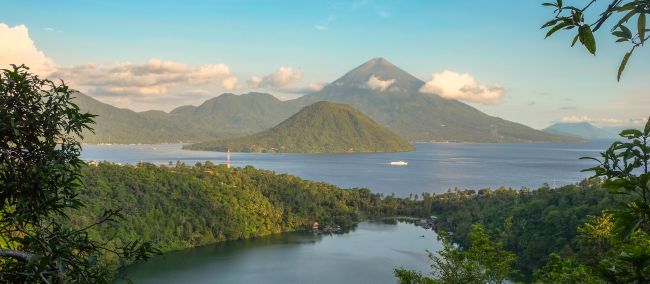
The spectacular volcanic landscapes of North Maluku
Blog home / Indonesia’s remote islands of spice, science and rare species
This article is a snippet from the Traveller article written by Nick O'Malley.
From above, Ternate is a mere pinprick in the more than 1000-island strong Indonesian archipelago of Maluku. But, in its own way, this place has helped shape the world as we know it today. The aroma of nutmeg and cloves here has been largely replaced by the exhaust fumes of countless motor scooters, but the precious spices still grow in the island’s forests – spices that enticed Arab, Persian and Indian traders to this remote part of the world more than a thousand years ago.
Where history, wildlife and wild reefs collide
I find myself in Ternate, 3347 kilometres east of Jakarta, as a guest aboard a 14-day, 13-night adventure cruise dubbed “Maluku & Sulawesi: Rare Species, Cultures & Corals”.
I’m sailing aboard Ombak Putih, a 42-metre twin-masted schooner or phinisi, as the traditional coastal traders of seafaring Sulawesi, Indonesia’s fourth-largest island, are known. The vessel comfortably accommodates 24 passengers in 12 en-suite cabins, all of which are, thankfully, equipped with air-conditioning.
Back on the island, an abundance of spices isn’t this region’s only claim to notoriety. There are those who believe that the greatest single idea ever to have fizzed into a human mind was first described in a little house on a side street of Ternate, the island’s small but seething eponymous city.
It was in 1858, inside a building that today houses a pet shop, that Alfred Russel Wallace, a self-taught Welsh naturalist, wrote his famous 1858 essay on evolution by natural selection. Wallace laid out his theory that earthly species evolved into their glorious variety via a competitive mechanism he called the “natural means of selection”.
He was at the time four years into an eight-year scientific expedition across the waters in which the Ombak Putih is sailing. Of course, the same theory had occurred to Charles Darwin 20 years earlier, after his celebrated voyage on HMS Beagle. But Darwin – doubtless concerned he may have inadvertently challenged the existence of a god responsible for the creation of all creatures great and small – had conveyed his theory only to trusted confidants, consigning his notes to a desk drawer.
Still intending to publish, Darwin was appalled to receive what became known as the “Letter from Ternate” from Wallace, detailing the same theory in startling detail. Nonetheless, Darwin bundled Wallace’s essay with sections of his own treatise and had the papers published together, effectively rendering the pair co-discoverers. What was at first known as the Darwin-Wallace theory of evolution drew little attention for a time, but it would come to upend the world’s understanding of science and nature, botany and biology, of philosophy and religion.
The Ombak Putih’s passengers are treated to an esteemed guest lecturer, namely Dr George Beccaloni, a former curator at London’s Natural History Museum and one of the world’s leading authorities on Wallace.
Our two-week voyage around the Molucca Sea will include visits to the islands that shaped Wallace’s work.
Exploring the Molucca Sea
My fellow passengers skew adventurous by demeanour and older by years. We come to know each other well over communal meals of curries, fresh fish and fruit on deck over the coming days. It doesn’t take long for those days to take on a grand sort of rhythm. The longer stretches of the cruise are made overnight, with guests waking on most mornings over new reefs to explore.
Remarkably, and especially by comparison to the sections of our own Great Barrier Reef which I have visited over recent years, the coral here is in spectacular health. And while the reefs at first blur, one into another, after enough time in the water you realise each is different. One afternoon we swim a half-moon formation around a tiny island where all I see is thriving life, but Dr George – whose greatest enthusiasm beyond Wallace is Indonesia’s reefs – points out sections cloaked in algal growth.
This is evidence, he explains, that the fish that would normally clean it have fallen in number. It’s then that I notice that the shoals we swim among are numerous but tiny. Anything big enough to make a meal has already been eaten.
One day we roll off the side of the rigid inflatable boats (RIBs) into a sanctuary for giant clams, their great fat lips spilling vivid blue and green over metre-long shells. Our tour leaders, Dion Luas and Tinae Ringo, constantly patrol for creatures that might delight. One will find, say, a seahorse or a moray eel and a yell will rise from the water and we’ll all form an earnest aquatic huddle.
A few mornings later and in the darkness a little after 4am, half our ship’s party bundle into the RIBs and head to shore, the passengers locked into a tired silence as the faces of the boat pilots glow red from the essential navigation lights. The plan is to trek into the foothills of the Sibela Mountains in time to see birds of paradise perform their courting ritual at dawn. These birds were important to Wallace. He noted they existed on the eastern side of what we know today as the “Wallace Line” – the boundary he first identified in 1859 that divides the flora and fauna of Australasia and Asia.
To the east you find tree kangaroos, cockatoos and birds of paradise; to the west, tigers and primates. Something, he realised, had caused life to evolve differently on either side of the divide. He could not have known this was the product of the ancient collision of two tectonic plates, but he was the first to note the effect. It would not be until the 1960s that the cause – continental drift – was properly understood.
Words by Nick O'Malley, who travelled as a guest of On Water Expeditions. Read his full experience.
HOW TO EXPERIENCE IT
INCLUSIONS:
- 13 nights twin share cabin accommodation aboard an intimate 24-guest sharing traditional Indonesian sailing boat
- 13 breakfasts, 13 lunches and 13 dinners
- Park entrance fees and boat levies
- Snorkelling equipment
- Use of kayaks and paddle boards
- Local, passionate guide and expertly trained crew
- Airport transfers