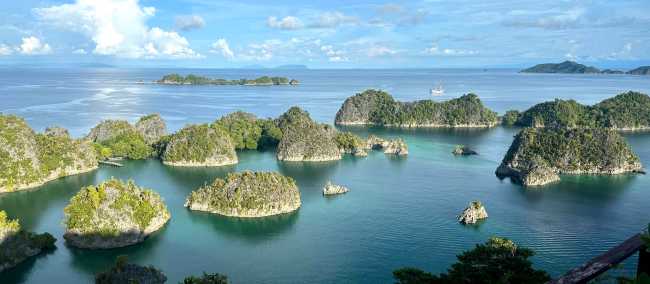
Spectacular Misool Island, Raja Ampat | Rachel Imber
Blog home / In the Footsteps of Wallace: Tracing the Origins of Evolution Through the Coral Triangle
In the history of science, few names shine as brightly — and yet as quietly — as Alfred Russel Wallace. Often called the “forgotten father of evolution,” Wallace was a self-taught naturalist, explorer, and one of the earliest proponents of natural selection. His life story is not just one of scientific discovery, but also of courage, curiosity, and a deep reverence for nature. And the beating heart of that story? The biodiversity-rich islands of Indonesia, nestled in what we now call the Coral Triangle.
A Parallel Discovery: Wallace and Darwin
Most people associate the Theory of Evolution with Charles Darwin, but Wallace independently developed a very similar theory — in fact, it was his now-famous 1858 letter to Darwin outlining natural selection that pushed Darwin to publish On the Origin of Species the following year.
Rather than rivals, the two became respectful collaborators. Darwin once described Wallace as “the man who had the best claim to the co-discovery of natural selection.” Unlike Darwin, Wallace developed his theory in the field, deep within the equatorial forests of the Malay Archipelago.
Wallace’s Indonesian Odyssey
Between 1854 and 1862, Wallace travelled over 22,000 kilometres through present-day Malaysia and Indonesia, collecting more than 125,000 specimens, including 5,000 species new to science. His work culminated in the seminal book The Malay Archipelago, a vivid travel memoir blending biology, geography, and anthropology.
Indonesia became the backdrop for his most important insights. On these islands, Wallace observed sharp divides in species distribution - monkeys on Bali, marsupials on Lombok - despite their close geographic proximity. This led to the identification of the now-famous Wallace Line, a biogeographical boundary that still defines how scientists understand species evolution in Southeast Asia and Australasia.
The Coral Triangle: A Living Laboratory
Today, the region Wallace explored is part of what we now call the Coral Triangle, which spans Indonesia, the Philippines, Papua New Guinea, and parts of Malaysia and the Solomon Islands. This area is home to:
Over 600 species of reef-building corals
More than 2,000 species of reef fish
Iconic creatures like the bird of paradise, Komodo dragon, and Sulawesi macaque
It’s not just a biodiversity hotspot — it’s a living museum of evolution. For those passionate about nature, science, or adventure, visiting the Coral Triangle offers the chance to walk through a real-world evolutionary laboratory.
Why Wallace Still Inspires
Wallace’s story is one of persistence without privilege. Born into a modest background, he funded his expeditions by selling specimens to collectors back in Europe. His humility, egalitarianism, and sharp observational skills made him a scientist of the people — and a man ahead of his time.
He also paved the way for a more holistic approach to science — one that valued local knowledge, respected indigenous communities, and saw conservation as a moral duty long before it was fashionable.
Follow in His Footsteps
Want to trace Wallace’s journey? You can:
Explore Ternate and Tidore – volcanic islands where Wallace wrote his famous letter to Darwin.
Visit Sulawesi – home to unique species found nowhere else on Earth.
Dive in Raja Ampat or Wakatobi – coral paradises teeming with life.
Walk through Borneo’s rainforests – where Wallace marveled at the orangutans and butterflies.
Each step is a journey through both space and time - a connection to the pulse of evolutionary change that Wallace helped uncover.
A Legacy Worth Rediscovering
Alfred Russel Wallace didn’t just uncover the secrets of evolution; he left behind a trail that modern adventurers, scientists, and nature-lovers can still follow. His work remains a powerful reminder that the world’s greatest discoveries are often waiting in its wildest places.
So, if you’re yearning for wonder - for a chance to see what Wallace saw and to feel what he felt - head east into the Coral Triangle. The spirit of scientific discovery is still alive there, waiting in the trees, reefs, and skies.